🕯️ Ritual Guides
How to Cast a Love Spell on a Specific Person
Naming a person is normal when you want to reopen a real bond. The line is will. Here is the ritual I teach and the limits I keep.
Most people who ask me how to cast a love spell on a specific person are thinking of one face. A former partner, a friend who has started to feel like more, a coworker they can’t stop noticing. The question carries two others inside it: is it allowed, and will it work?
I’ll answer both, and I’ll draw a line while I do. Naming a person in a ritual is normal in this work. What matters is what you ask the ritual to do. Asking for a path to open, and for you to be ready to walk it, is one thing. Asking to take someone’s choice away is another, and I won’t help with that, now or ever.
I’m Baba Ali. I’ve worked in the Senegalese ancestral tradition I was taught for more than 30 years, and I’ve sat with a great many people who wanted one particular person. Here’s how I think about it, including a seven-night candle ritual of my own that you can do at home.
Quick answer
How to cast a love spell on a specific person: name them as the focus of an intention that leaves their choice free, like opening a path or softening a quarrel. Don’t force feelings. Use candles, plain words and your own actions, and accept that they may say no.
Key takeaways
- Naming a person is fine when the aim leaves them free to answer yes or no.
- Work that forces, deceives or breaks up another relationship is where I draw the line.
- A ritual changes you first, and that change shows up in how you act around them.
- The seven-night ritual below works on your openness and your words, not on their mind.
- If they say no, stop, release the work and look after yourself.
Last reviewed: November 2026 by Baba Ali

How do you cast a love spell on a specific person without crossing a line?
Yes, in the sense that you can name a person as the focus of your intention. Whether you should depends on what you ask for. A request that leaves the other person free to respond is fair. A request designed to make them feel or act against their wishes isn’t.
I know that “cast a spell on someone” has a menacing ring. In popular stories it means a victim and a schemer. Real practice is usually quieter. People name a person because their wish is about that person: they want to reconnect, to heal a rift, to be noticed, or to find the courage to speak. The name keeps the work from drifting into vagueness.
A related question is whether naming a person gives you power over them. I don’t believe it does, and I’d be wary of anyone who says it does. In my tradition, a name works like an address on a letter. It tells the work where your attention is pointed. It doesn’t give you a hold on the person.
For more on how consent fits into ritual work, read my guide on love spells and free will, and my page on ethical love spell practice.
What does naming a person actually do?
Naming a person does three things. It focuses your attention on one real human, so your wish stops floating. It forces you to look squarely at what you want from them. And in the view of this tradition, it directs the work toward a specific bond.
Take the first. Wishes get stronger when they’re specific. “I want love” is a mood. “I want to repair things with this person” is a project. The name gives the work a shape.
The second is subtler. When you write a name and then write what you hope for next to it, you often see something you hadn’t noticed. Maybe the wish is “I want them to apologize,” and you realize you actually want to feel respected. Maybe it’s “I want them back,” and you realize you want to be chosen. Those are different goals, and they call for different steps.
Last comes the part I can’t prove. In my tradition, a named working is aimed at a particular bond, and it can support that bond if there’s something there to support. It can’t create a bond that isn’t there, and it can’t override the other person’s decision.
Where is the line? Three tests before you name anyone
The line sits where your request stops leaving the other person free. Here are three tests I use, in plain language.
| Test | A fair request | Over the line |
|---|---|---|
| Choice | “Let a path open, if they want it.” | “Make them feel what I want them to feel.” |
| Honesty | “I’d be fine if they knew what I was doing.” | “They must never find out.” |
| Others | “This involves only the two of us.” | “I want them to leave their partner.” |
The choice test asks whether the other person remains free. If your request only works when they have no say, it’s over the line. The honesty test asks whether you’d be comfortable if they knew. If you’d be mortified, ask what that tells you. The others test asks whether anyone else gets caught in it. A partner, a child or a family member who hasn’t agreed to be part of your wish deserves the same respect.
If you pass all three, you’re on honest ground. If you fail one, pause. If you fail two, please don’t proceed. I explain my reasoning in more depth in do love spells give you bad karma, and on the subject of partners, in can a love spell make someone leave their partner.
Who is this for, and who should wait?
This kind of work suits people who want to reconnect with someone they already have a history with, repair a rift, or prepare for an honest conversation. It suits you if you can accept a no.
Here’s how the common situations break down.
A former partner is the most common case, and the work can focus on reopening a path and on your readiness. It works best with a calm stretch of space between you, and my guide on how to trigger an ex to come back explains what steadiness looks like.
With a partner you’re drifting from, the work can focus on warmth and honest talk. It should come with real conversations, and perhaps a counselor.
A friend or acquaintance you’ve started to feel more for calls for extra gentleness. A ritual shouldn’t replace saying something honest. Work on your courage, and let them choose.
For a crush you barely know, the honest version of the work is about you: being visible, confident and open. I’ll say more on that below.
If the person is married or committed to someone else, I won’t do work aimed at them. It involves a third party who hasn’t agreed. If you’re in that situation, the best help I can offer is to talk about what’s behind the wish.
If the person is under eighteen, or if the relationship is abusive, please stop and seek proper help. I don’t do work in either case.
What can a named ritual realistically do?
A named ritual can help you get clear, calm and ready, and in the view of this tradition it can support a path that may open. It can’t make a person feel something, can’t force a reply, and can’t undo a decision they’ve made.
The clearest benefit is on your side. People who do honest work with a name in mind often report that they feel steadier. They stop spiraling. They choose their words better, and they stop reacting to every small thing. That shift changes how they come across, and it changes what’s possible.
A second benefit is timing. The work often prompts people to act on something they’ve been avoiding: a message they’ve been drafting for weeks, an apology they owe, an invitation they’ve held back. The ritual gives them a push.
A third is closure. If the person says no, a ritual that has trained you to accept an answer makes that no easier to take.
The ritual work I do finishes within three to seven days, and what the other person does with an opening runs on their own clock. If you’d like to understand timelines, read how long after a love spell will your ex contact you, and for how to read what follows, how do I know if a love spell is working.
How should you prepare?
Prepare by getting clear on your sentence, clearing your space, and gathering plain materials. Give yourself a quiet evening, a tidy table and a calm mind. If you’re furious, exhausted or desperate, wait a day.
Your sentence. Write one line that states what you hope for, in positive words, with the person’s name and a clause that leaves them free. For example: “I open a path to honest conversation with Sam, if Sam wishes it, and I’m ready for whatever answer comes.” Notice the clause. That’s the heart of fair work.
Your materials. You’ll need:
- One white or pale pink candle for each night (seven small candles or tealights work), and a heat-safe dish.
- Matches and a snuffer, or a spoon to snuff the flame.
- A notebook and a pen.
- A small bowl of salt and, if you like, a few dried rose petals.
Clear the space first. Tidy the table, open a window, and wash your hands and face. My guide on spiritual cleansing before love spells offers more ideas. For candle colors and what they stand for, see candle colors for love magic, and for flame behavior, candle flame meanings.
A word on safety
Never leave a lit candle unattended. Keep flames away from curtains, paper and hair, keep pets out of the room, and snuff the candle at the end of each session. If you feel intense distress at any point, stop and talk to someone you trust. In crisis in the US, call or text 988. If you feel unsafe because of this person, contact the National Domestic Violence Hotline.
The seven-night candle ritual: opening the path
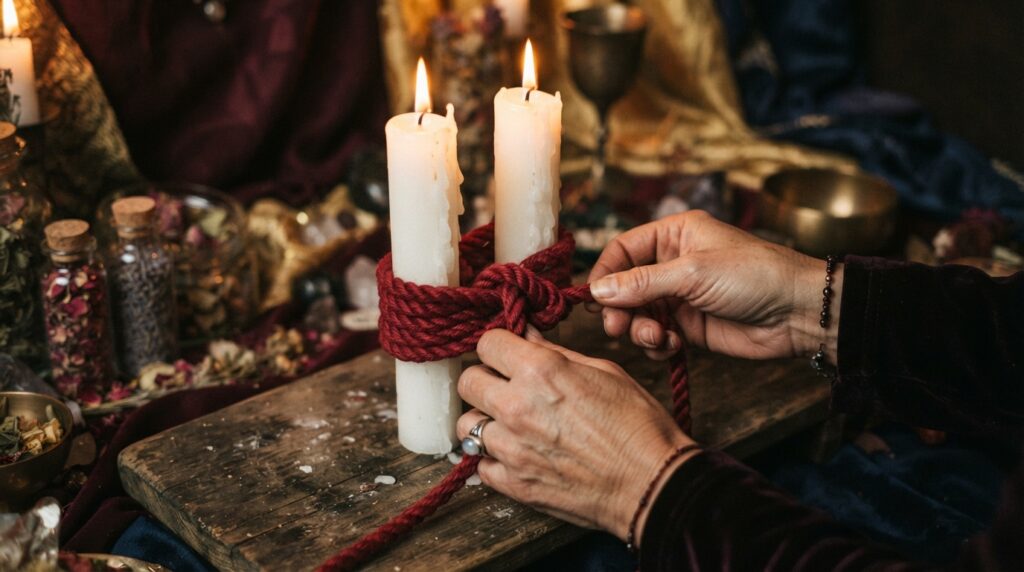
This is how to cast a love spell on a specific person without taking anything from them: the ritual works on you. Each night takes about ten minutes. Do it at the same hour if you can. Light a fresh candle, read the line for the night, spend a few minutes in the task, and snuff the flame. Write one sentence in your notebook each night. The ritual is original. I wrote it to be honest about what it can and can’t do.
NIGHT 01Naming
Light the candle and say your sentence aloud. Then say: “I name this wish and I name my limits. I seek an open path and not a closed hand.” Write the person’s name and your sentence in your notebook. Sit for a minute, then snuff the candle.
NIGHT 02Release the grip
Light the candle. Write down any outcome you’re clinging to, such as “they must call by Friday.” Read it aloud, then say: “I loosen my grip.” Fold the paper and put it under the dish. The aim is to hold your wish with an open hand.
NIGHT 03Your own heart
With the candle lit, write three things you value in yourself that have nothing to do with this person. Read them aloud. Say: “I am whole whether or not this path opens.” This is the night that does the most for your steadiness.
NIGHT 04The honest word
Once the flame is steady, write the clearest, kindest message you’d send to them if you could, with no pressure in it. Read it aloud. You don’t have to send it. Often you’ll see what you’d actually say, and that’s the point.
NIGHT 05Their freedom
Strike the match and say aloud: “I honor your right to choose.” Imagine them living well, whatever they decide. If you feel resistance, sit with it. This night is about generosity, and it’s the hardest one for many people.
NIGHT 06The next small step
Light the candle. Write one concrete, kind action you’ll take in the coming week. It might be a message, an apology or a decision to give them space. Say aloud: “I will do my part.” Choose something small and doable.
NIGHT 07Closing
Light the candle. Read your notebook entries from the week. Say: “I have done what is mine to do. I release this into the world and I return to my life.” Snuff the candle. Drop the folded paper from Night 2 into the salt bowl, and throw the salt and paper away outside.
After the seventh night, stop. Don’t repeat the ritual next week because you feel anxious. If the urge to repeat comes, write about it instead, and put the notebook away.

A fair spell asks for a door to open. It never asks for someone to be pushed through.Baba Ali
What should you do between the nights, and after?
Live ordinarily, and do the small step you wrote on Night 6. The ritual works on your readiness, and what you do with that readiness is what the other person sees.
Between nights, keep your routine. Eat, sleep, work and see friends. Don’t track the other person. Don’t ask friends to report on them. Don’t post to provoke them. If you’ve agreed with yourself to a period of no contact, keep to it.
After the seventh night, give the whole thing a few weeks. If they reach out, reply warmly and briefly. If they don’t, don’t chase. Read my guide on what to do after a love spell is cast for a full aftercare list.
If you’d like help reading what follows, my guide on how to tell if your ex is coming back after a spell gives a two-week method, and signs your ex is coming back after a spell lists the signs by strength.
How do you know when to stop?
You stop when they say no, when the work starts to feel like pressure, or when you’ve done your seven nights and your step. Stopping is part of honest practice, and it takes courage.
If the other person says no, clearly and more than once, believe them. Release the work, using the steps in how to break a love spell, and give yourself time to grieve. A ritual can’t change a stated decision, and I wouldn’t try.
If you notice yourself repeating the ritual, checking their profile, or wanting to add something “stronger,” stop. Those urges are a sign that you’re trying to control the outcome. Talk to a friend or counselor.
If your life has narrowed to this one wish, pause it. A wish this large needs a larger life around it.

Why do coercive spells fail, and what do they cost?
Coercive spells fail because they try to build something real out of something forced. Even if a person seems to change, you can’t tell what’s real and what isn’t, and neither can they. That doubt eats at a relationship.
There’s a cost to the caster as well. People who force a bond tend to live with guilt, with suspicion and with the nagging question of whether the other person would have chosen them freely. In the tradition I was taught, harm work returns to the one who casts it. Whatever you believe about that, the human cost is plain. You’d be married to a question mark.
There are practical costs too. A relationship that depends on secrecy can collapse the moment the truth comes out. And if coercion crosses into harassment or control, it can have legal consequences and cause real harm.
If someone offers to do forced work for you, think about why. A practitioner who’ll do anything for a fee isn’t protecting you. They’re protecting the fee. My guide on how to tell a love spell caster is a scam lists the signs.
What about a crush or someone you barely know?
For a crush or a near stranger, the honest work is about you. You can’t know what’s in a stranger’s heart, and a ritual aimed at them is guesswork. A ritual aimed at your own confidence, warmth and visibility is something you can actually use.
Here’s what that looks like. You name your wish: to be seen, to speak up, to meet people. You do a short candle practice for readiness, as in the seven-night ritual above with Nights 3, 4 and 6 doing most of the work. And you take the real step: introduce yourself, join the group, say hello.
If the person turns out to be interested, wonderful. If not, you’ve grown, and you’ll be ready for whoever is. For those starting out, my love spells for beginners guide and my page on a soulmate attraction spell offer gentle ways to begin.
How I handle work involving a named person
When someone asks me how to cast a love spell on a specific person, or to do it for them, I begin with questions. Who is this person to you? What happened? What do you hope for? What will you do if they say no? I listen for force, secrecy and third parties. If I hear them, I say so plainly and explain what I will and won’t do.
If the request is fair, I prepare work for the specific situation and finish it within three to seven days. I don’t charge for the spiritual work. In my tradition it isn’t done, so the client covers only the materials needed for their case, and any gratitude afterward is a free-will gift. I won’t promise a result. Nobody honest can.
If you’d like to talk through your own situation, the free 30-minute consultation is a plain conversation with no obligation. My candle magic ritual service and the broader how to cast a love spell guide explain the work in more detail, and my candle magic guide covers safe practice.
Thinking about naming someone in a ritual?
Tell me about the person and what you hope for, and I’ll give you an honest read on whether it’s fair work and what I’d suggest. The first 30 minutes are free, there’s no obligation, and if any work follows, you cover only the materials.

What mistakes do people make when they name someone?
The mistakes are common and fixable. Naming too many people at once is the first. If you name three possible partners, your wish blurs. Pick one real person, or work on yourself.
Another is writing the other person’s feelings into your sentence. “Sam loves me” isn’t a wish. It’s a command. “I open a path to honest conversation with Sam” is a wish.
Skipping your own part is a third. People light candles and then wait for the phone. The ritual is meant to move you toward action, and the action is what the other person sees.
Telling mutual friends is a fourth. It spreads your private wish, and it can reach the other person in a distorted form. Keep this to yourself and one trusted confidant.
Doing it in a rage or a panic is a fifth. The work carries your mood. If you’re furious, wait. If you’re desperate, wait. A calm evening is better than a frantic one.
And the sixth is repeating the ritual because the first time brought no reply. Another seven nights won’t change what the first seven did. Rest, review and, if you want a second opinion, ask for one.
Frequently asked questions
Can you cast a love spell on a specific person?
You can name a person as the focus of an intention that leaves their choice free, such as opening a path to reconnect. You shouldn’t try to force feelings, deceive them or pull them from a partner. A fair request accepts that they may say no.
Is it ethical to cast a love spell on someone?
It can be, if the work respects their free will and harms no one. Ask whether they remain free to choose, whether you’d be comfortable if they knew, and whether anyone else is affected. If you can’t answer yes to the first two, reconsider.
Do I need the person’s photo or belongings?
No. A name and a clear intention are enough for the home ritual in this guide. Be wary of anyone who insists you send photos, personal items or large sums as a condition of the work. Those requests are common in scams.
Will the person know I cast a spell on them?
There’s no reliable way for them to know, and a fair request wouldn’t need secrecy anyway. I suggest you only do work you’d be comfortable explaining to them. If you wouldn’t, that’s a signal to rethink your request.
Can I cast a love spell on a crush?
You can, but the honest version works on you: your confidence, warmth and visibility. You can’t know what’s in a stranger’s heart, and a ritual aimed at it is guesswork. Pair the work with a real step, such as saying hello.
Can I cast a love spell on someone who’s in a relationship?
I don’t do work aimed at a person in a committed relationship, because it involves a third party who hasn’t agreed. If you’re in that situation, the better help is talking about what’s behind the wish and what you actually need.
How long does a love spell on a specific person take?
The ritual work I do finishes within three to seven days. What the other person does with an opening runs on their own clock, which may be days, weeks or never. Nobody can promise a date, so be wary of anyone who does.
What if the person says no?
Believe them. Stop any ongoing work, release it with a clean ending, and look after yourself. A ritual can’t change a stated decision, and trying to push past a no harms you both. Grief is normal, and a friend or counselor can help.
Can I do this ritual more than once?
I’d advise against repeating it right away. Review your notes after a few weeks and ask whether your wish has changed. If you want a second opinion before doing anything again, book a consultation. Repeating a ritual out of anxiety usually makes the waiting harder.
More Sacred Wisdom

Ready to Reunite With Your Soulmate?
If the signs are speaking to you, do not let the moment pass. Book a free consultation with Baba Ali today and discover the sacred path back to the love you deserve.