
Love Spell Candle Flame Meanings: Wax, Smoke and Candle Colors
A reference guide to what each candle color has represented across love-work traditions, why red means what it means, and why black is not the color of malice people assume it is.
Color carries symbolic weight in nearly every spiritual tradition on earth, and that weight did not appear by accident. Red has meant blood, heat, and life force for as long as human beings have made fire. White has meant purity and beginning for as long as they have watched dawn follow night. When a candle is lit in love work, its color is not a marketing choice or a rule copied from a spellbook. It is a small, deliberate act of borrowing meaning that older than any of us, and this guide exists to explain that meaning properly, color by color, tradition by tradition.
I am Baba Ali, a Senegalese spiritual practitioner trained from childhood by my grandmother in the Serer and Wolof traditions of ancestral love magic. In more than thirty years of practice and over 5,000 client workings, I have answered the same question in a hundred different phrasings: “why does the color matter?” This piece is my full answer. It is not a shopping list. If you came here looking for “which color should I buy for my situation,” my companion guide, Candle Colors for Love Magic: The Complete Guide, handles that practical question directly. This piece goes underneath it, into what each color has actually represented across history and across traditions, so the practical choice makes sense rather than feeling arbitrary.
What This Guide Is, and Isn’t
This is a symbolism reference, not a step-by-step ritual guide. It explains what each color has represented historically and spiritually. For guidance on which color fits your specific situation, timing, and intention, see the practical companion guide linked above.
Love Spell Candle Flame Meanings: Why Color Carries Meaning in Ritual Work at All
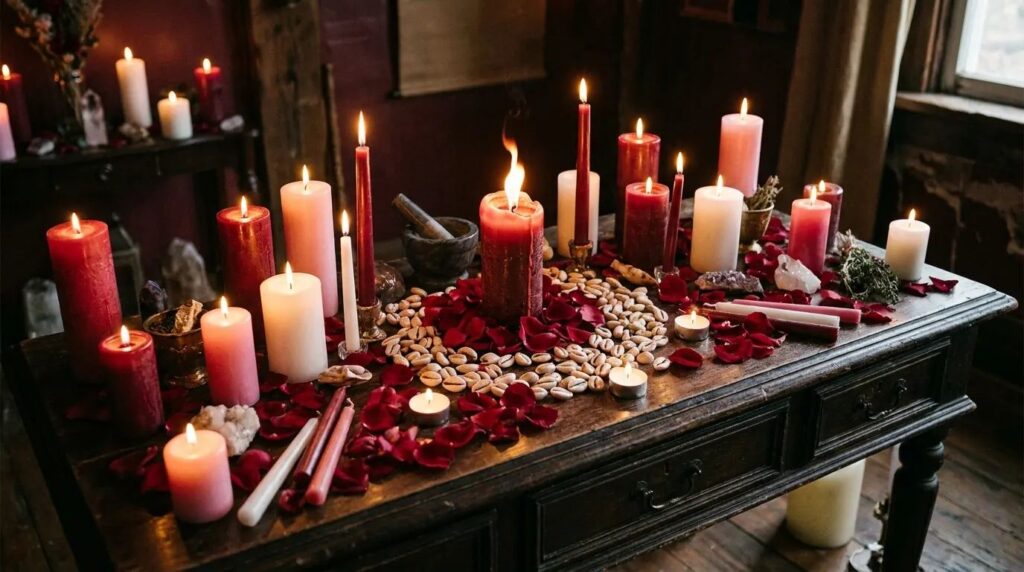
Before the table, the reference needs a foundation, or it just becomes another list to memorize. Color meaning in ritual work did not start in a book. It started in observation. Ochre and blood share a hue, so red became associated with life and its opposite. Ash and bone share a hue, so white became associated with what remains after transformation, and later with purity and clean beginnings. The night sky is deep, near-black purple at its darkest hour, which is also the hour associated with dreaming, with the veil between worlds thinning, and with the deepest kind of spiritual work. None of this is superstition dressed up as meaning. It is meaning built the honest way, through thousands of years of people noticing what colors correspond to in the natural world and carrying that correspondence into ceremony.
In my own tradition, color also carries elemental and directional weight — a candle’s color connects it to fire, water, air, or earth, and to a particular quality of energy that element brings to a working. A red candle does not just “mean” passion the way a stop sign means stop. It carries fire’s heat, fire’s speed, and fire’s tendency to consume what it touches quickly rather than slowly. That is a meaningfully different kind of information than a flat translation table would give you, and it is why this reference goes deeper than color equals feeling.
There is also a practical reason this history matters beyond curiosity. A practitioner who understands why red carries urgency, rather than simply memorizing “red equals love,” will notice when urgency is not actually what a situation calls for. I have sat with clients who came to me certain they needed a red candle because that is what every online list told them, when what their relationship actually needed was the patience of green or the calm of blue. Knowing the roots of a color’s meaning gives you the judgment to choose correctly instead of following a label. That judgment is the entire point of a symbolism reference like this one, and it is the piece that gets lost when color meaning gets reduced to a shopping list.
I should also say plainly that color symbolism is not identical to superstition, even though the two get confused constantly in casual conversation about spiritual practice. Superstition treats a color, a number, or a gesture as inherently lucky or unlucky with no underlying logic behind the claim. Color symbolism, at least the version I was taught and the version this reference describes, traces a line from observed natural fact (blood is red, ash is white, the deepest night sky is nearly black-purple) to symbolic meaning to ritual application. Each link in that chain can be explained. That is a meaningfully different kind of claim than “black cats are unlucky,” and treating the two as the same thing is one of the more common mistakes I see people make when they first encounter ritual color work.
The Candle Color Symbolism Reference Table
Here is the full reference, color by color, with the element it is most consistently paired to across traditions I have studied or worked alongside, and the emotional and symbolic core each one carries into love work specifically.
| Color | Element | Energetic Association | Symbolic Meaning in Love Work |
|---|---|---|---|
| Red | Fire | Solar, high-intensity, active | Passion, desire, life force, urgency |
| Pink | Water / Air blend | Gentle, receptive, warming | Affection, tenderness, self-love, new romance |
| White | All elements / spirit | Neutral, amplifying, cleansing | Purity, new beginnings, all-purpose substitution |
| Gold | Sun / spirit | Radiant, expansive, blessing | Divine favor, abundance in love, honored connection |
| Black | Earth / void | Grounding, absorbing, containing | Protection, banishing, cord-cutting, boundary |
| Green | Earth | Growing, stabilizing, patient | Lasting commitment, growth of an existing bond, prosperity in partnership |
| Orange | Fire / Air blend | Energizing, communicative | Attraction, encouragement, forward motion |
| Purple | Spirit / water | Intuitive, elevated | Deep spiritual bonding, karmic or soulmate connection |
| Blue | Water | Calming, clarifying | Peace after conflict, honest communication, healing |
Nine colors, not one of them interchangeable in meaning even where they overlap in use. That overlap is the part most guides skip, and it is exactly where the confusion around candle color usually starts.
The Five Colors Most Used in Love Work, Explained in Depth
These five carry the most symbolic weight in the love work I perform and teach, so each deserves more than a table row. I want to walk through where the meaning comes from, not just state it.
01Red: Passion and Life Force
Red is the oldest color association in ritual work generally, not just in love magic. Across cultures with no contact with one another, red has meant blood, meant heat, meant the visible evidence of a body that is alive. Ancient Egyptian ritual used red ochre for vitality. Chinese wedding tradition still uses red as the color of good fortune and union. My own tradition treats red as fire’s candle: fast-acting, intense, and demanding of respect, because fire that is not contained burns what it was meant to warm. In love work, red carries desire and urgency more than steadiness. It is the color of a spark, not the color of a foundation being laid slowly. That distinction matters more than most people realize when they reach for red automatically because it is the “love color” on a store shelf.
02Pink: Gentle Affection and Self-Love
Pink is red diluted by white, and its meaning follows that formula almost exactly. It carries passion’s warmth without passion’s intensity, softened by white’s association with purity and new beginnings. Pink’s symbolic territory is tenderness rather than fire: the early stage of a new connection, the rebuilding of affection after a rupture, and increasingly in modern practice, self-love work aimed inward rather than at another person. That last use is relatively recent in ritual language but has become one of the most common reasons clients ask for pink candles specifically, and I think it is a genuinely good development. A tradition that only ever pointed candle work outward, at another person, was missing half the picture.
03White: Purity and New Beginnings
White holds a unique place in candle symbolism because it functions as both a specific meaning and a universal substitute. Specifically, white represents purity, clarity, and the clean slate of a genuine new beginning; it is the color most often used to open a working, to bless a space before deeper work begins, or to represent a connection still in its earliest, unformed stage. As a substitute, white is understood across nearly every candle tradition I know of, including my own, to carry all colors within it and to stand in for any color that is unavailable. That dual role is not a contradiction. Light itself works the same way: white light contains the full spectrum, and a white candle is treated the same way symbolically.
04Gold: Divine Blessing and Prosperity in Love
Gold’s meaning comes directly from what it represents materially in nearly every culture: value that does not tarnish, wealth, and the sun’s light made physical. In love work, gold carries a specific flavor of meaning that is less about passion and more about honor — a connection blessed, elevated, worth protecting because of what it is worth. I use gold candles in work aimed at strengthening or honoring a bond that already has real substance, rather than in work meant to spark something new. Gold is also, in my tradition specifically, associated with ancestral blessing. Lighting a gold candle is, in part, an invitation to ancestors and spirit to bless the connection being worked on, not just an aesthetic choice.
05Black: Protection, Not Malice
Black is the most misunderstood color on this entire list, and I want to correct that clearly. In popular imagination, black candles mean curses. In actual ritual tradition, across the traditions I know, black means protection, absorption, grounding, and the clean severing of what needs to end. Black is the color of the void that holds and contains rather than the color of harm. In love work specifically, black is used to cut old attachment cords cleanly, to protect a new connection from outside interference or jealousy, and to ground a working so its energy does not scatter. A black candle used to cut a cord to a past relationship is doing protective work for the client’s own healing, not aggressive work aimed at anyone. That distinction is not a minor technicality. It is the entire difference between ethical practice and the kind of manipulation I decline to perform.
Other Colors Worth Knowing
Beyond the core five, four other colors appear regularly enough in love work to deserve their own explanation rather than a single table line.
Green belongs to earth and carries growth, patience, and material stability. In love work it is used less for sparking a connection and more for nurturing one that already exists — a relationship moving toward commitment, a partnership that needs its practical, day-to-day foundation strengthened alongside its romantic one. Earth is the slowest of the elements to respond and the most durable once it does, which is exactly the quality green candle work is meant to carry: not fast, but built to hold. I use green far more often in work for couples who are past the spark stage and into the harder, slower work of building a life together, where finances, shared responsibility, and daily patience matter as much as feeling.
Orange sits between red’s fire and gold’s radiance, carrying attraction and forward motion without red’s urgency; it is often the color used for work meant to encourage a hesitant connection to move forward at a natural pace. Where red pushes, orange invites. I reach for orange specifically when a client describes a connection that has stalled, not because the feeling is absent but because one side or both is hesitant to act on it, and the goal of the working is to open a path forward rather than force one.
Purple belongs to spirit rather than any single element, and carries the deepest, most intuitive symbolic weight on this list, associated with karmic or soulmate-level connection and with communication across the veil to ancestors and guides. Purple work tends to be slower and quieter than red or orange work, more about revealing what is already true between two people than manufacturing something new. When a client asks whether a connection is “meant to be,” purple is the color I most often light while sitting with that question honestly, because the answer that comes from that kind of work tends to be more trustworthy than the answer that comes from wishful thinking alone.
Blue belongs to water and carries calm, clarity, and healing, and I reach for it most often in work aimed at repairing communication after conflict rather than sparking new passion. Blue candle work has a specific and, in my experience, underused role: cooling a situation down before anything else can be built on top of it. A couple in the middle of active conflict rarely benefits from a passion-focused working laid on top of unresolved anger. Blue clears that ground first.
Silver is less commonly discussed than the nine colors above, but it earns its place in a full reference. Silver is tied to the moon rather than the sun, and carries reflection, intuition, and the revealing of what is hidden. In love work, silver is used for clarity workings, situations where a client needs to see a connection honestly rather than through hope or fear, and it pairs closely with lunar timing, which I cover in more depth in the moon-phase guide linked later in this piece. Brown, similarly underused, belongs to earth alongside green but carries a narrower, more grounded meaning: stability of home, hearth, and daily domestic life specifically, rather than growth in the broader sense green represents. A brown candle shows up more often in workings meant to steady a household or a shared home than in workings meant to grow a new romantic bond.
Combining Colors in a Single Ritual
Most of the workings I perform use more than one candle color, not one alone, and this is a piece of the symbolism that a color-by-color reference can make invisible if it is not addressed directly. Colors are not chosen in isolation. They are combined the way a cook combines ingredients, each one contributing a specific quality to a working built for a specific situation, and the combination matters as much as any single color does on its own.
A common pairing in my own practice is red with white: red for the intensity of desire, white to hold and steady that intensity rather than letting it burn out too quickly or scatter. Lit alone, red can produce a working that flares and fades. Paired with white, the same intensity has somewhere to settle. Another pairing I use often is gold with black: gold to bless and honor a connection, black to protect it from outside interference or old attachment that might otherwise pull energy away from what is being built. That combination shows up frequently in workings meant to defend a new relationship against jealousy, gossip, or an ex-partner who has not accepted an ending.
Green paired with pink appears in workings meant to grow tenderness into something lasting: pink opens the door to affection, green gives it the patience and stability needed to hold. Purple paired with blue shows up in deep reconciliation work, where purple addresses the soul-level bond between two people and blue clears the communication wreckage sitting on top of it. None of these pairings are fixed rules carved in stone. They are patterns I have found reliable across thousands of workings, built on the same elemental logic covered earlier in this piece: fire colors act fast, water colors calm and clarify, earth colors stabilize, and spirit colors deepen.
The number of candles combined in a single working also carries meaning in most traditions, including my own, though the specific correspondences vary by lineage more than the individual color meanings do. A single candle concentrates a working around one clear intention. Three candles, an arrangement I use often, layers three qualities into a single ritual, most commonly attraction, protection, and blessing lit together. I would caution against combining more than three or four colors in a single working without real reason for each one. A candle spread that tries to carry every meaning at once usually carries none of them clearly, the same way a sentence trying to say everything at once usually says nothing well.
How Symbolism Differs Across Traditions, and Where It Converges
No single culture invented candle color symbolism, which is exactly why the core meanings hold up so consistently across traditions that had no contact with one another. Red means intensity in Chinese, West African, and European folk practice alike, even though the specific rituals built around that meaning differ completely. White means purity and beginning in Senegalese Serer tradition, in Wiccan practice, and in Catholic liturgical use, again arrived at independently.
Where traditions genuinely diverge is in the details layered on top of the core meaning: which day of the week suits which color, which additional herbs or oils pair with a color, how many candles of a color should be lit together, what direction they should face. My own tradition has specific answers to all of those questions, passed down through my grandmother’s teaching, and another practitioner from a different lineage will have different specific answers with equal validity within their own tradition. What almost no serious tradition disagrees on is the core symbolic anchor: red is intensity, white is purity, black is protection and containment rather than harm, gold is blessing. That convergence is worth trusting. When a source tells you black candles are for cursing, that source is drawing from popular fiction and horror-movie shorthand, not from an actual living ritual tradition.
From Symbolic Meaning to Practical Ritual Choice
Understanding what a color means is the first half of the work. Choosing the right color for your specific situation, timing, and intention is a separate practical question, and it deserves its own dedicated treatment rather than a rushed paragraph at the end of a reference piece. If you know your love situation calls for reconciliation, new attraction, protection of an existing bond, or self-love work, Candle Colors for Love Magic: The Complete Guide walks through the color choice step by step for each scenario, including how to combine colors and what to do when the “correct” color is not available.
What I will say here, because it belongs in a symbolism reference too, is that the strongest ritual work usually pairs the symbolic meaning with the practitioner’s actual, honest intention rather than treating the color as a substitute for a clear intention. A red candle lit without a clear, specific intention behind it is decoration with a wick. The same red candle lit with a grounded, honest intention carries the full weight of everything red has meant across three thousand years of ritual practice. The color amplifies intention. It does not replace it.
Not Sure Which Color Fits Your Situation?
A short consultation can walk through your specific circumstances and what kind of working, if any, genuinely fits. No cost for the reading itself.
A color does not do the work. It carries the work further than a bare intention could travel alone. — Baba Ali
The Psychology Behind Why Color Affects Intention
Spiritual tradition is not the only field that has studied color’s effect on the human mind, and I think the overlap between the two is worth naming honestly rather than avoiding it. Color psychology research going back decades has documented that red reliably raises arousal and urgency in observers, that blue reliably lowers heart rate and reads as calming, and that warm colors generally read as more emotionally activating than cool ones across cultures with very different symbolic traditions layered on top. That is not a coincidence sitting next to ritual tradition. It is very likely part of the same underlying human wiring that produced the ritual traditions in the first place.
When a client lights a red candle and feels their own focus sharpen and their intention gain urgency, that is not “just psychology” as opposed to “real” spiritual effect. In my understanding of how this work functions, the two are not separate tracks running in parallel. The visual and physiological effect of color on the client’s own mind and nervous system is part of how the ritual functions, not a footnote to it. A candle color that makes the practitioner feel calmer, more focused, or more resolved is doing real work on the human side of the ritual, which then supports whatever is happening on the spiritual side. I do not think it is useful, or honest, to pretend those two levels are unrelated.
I want to be direct about the limits of this comparison too, because overstating it would be its own kind of dishonesty. Color psychology research generally studies short-term physiological response, arousal, calm, perceived warmth, measured in a lab setting, not the longer arc of a spiritual working carried out with clear intention over days. The overlap between the two fields tells us something true about why color affects the human mind and body the way it does. It does not, on its own, prove or disprove anything about the spiritual dimension of ritual work, and I am not claiming that it does. What I am saying is narrower and, I think, more honest: the physical, felt experience of lighting a color-specific candle is a real part of what makes that candle meaningful, and dismissing that as “just in your head” undersells how much the felt experience of ritual actually matters to its outcome.
Sources and further reading
- NFPA: Safety with Candles: Candle fire facts and tips, such as keeping candles 12 inches from anything that burns
Frequently Asked Questions
Is black candle symbolism really about protection and not curses?
Yes, in every serious ritual tradition I know, including my own. Black represents absorption, grounding, and containment, and in love work it is used for cutting old attachment cords and protecting a new or existing bond, not for causing harm. The curse association comes from horror fiction and pop culture, not from actual practice.
Why do red and pink mean different things if pink is just a lighter red?
Because the dilution changes the symbolic weight, not just the shade. Red carries fire’s full intensity and urgency; pink carries warmth without that intensity, closer to tenderness and gentle affection than to passion. The two are related but not interchangeable in what they represent.
Can white candles really replace any other color?
Yes, symbolically. White is understood across most traditions to contain the full spectrum within it, the same way white light contains every color of light. It is the standard substitute when a specific color is unavailable, and it also carries its own distinct meaning of purity and new beginnings.
Does the meaning of a color change between traditions?
The core meaning is remarkably consistent across traditions that developed independently of one another. What differs is the detail layered on top, timing, associated herbs, number of candles, which varies by lineage. Red means intensity almost everywhere; the ritual built around that meaning is where traditions differ.
Is gold the same as yellow in candle symbolism?
No. Yellow leans toward mental clarity and communication in most traditions, while gold carries a more specific meaning of blessing, honor, and prosperity, closely tied to the sun and, in my tradition, to ancestral favor. They overlap but are not treated as the same color symbolically.
Where can I find help choosing the right color for my specific situation?
This piece explains what each color means; the practical decision of which color fits your circumstances is covered in Candle Colors for Love Magic: The Complete Guide, which walks through scenario-by-scenario choices.
Which option fits reconciliation?
Blue is usually the first candle reached for — it cools active conflict and clears communication before anything warmer is layered on top.
What safety steps matter?
A stable heat-safe surface, never leaving it unattended, and keeping it away from anything flammable.
A Final Word From Baba Ali
I have watched candle color get flattened, over the years, into something closer to a color-coded shortcut than the layered symbolic language it actually is. Red for love, black for curses, white for whatever’s left over. That flattening loses almost everything that makes the symbolism useful in the first place. The real meaning behind each color, built over centuries by people watching fire, blood, ash, and dawn and drawing honest conclusions from what they saw, still holds up. Red is intensity. White is beginning. Black is protection, not harm. Gold is blessing. Understanding that fully will not, on its own, change your romantic circumstances. But it will change how deliberately you approach any ritual work you choose to do, and deliberate work has always outperformed guesswork in my experience.
If you want the practical next step, the companion guide will walk you through choosing a color for your exact situation. If you want spiritual guidance alongside that choice, I am here, and the first conversation costs nothing.
More Sacred Wisdom
Ready to Reunite With Your Soulmate?
If the signs are speaking to you, do not let the moment pass. Book a free consultation with Baba Ali today and discover the sacred path back to the love you deserve.
A Word on Safety
Never leave a candle burning unattended, keep it on a stable, heat-safe surface away from curtains or paper, and extinguish it fully rather than blowing it out if your tradition calls for pinching or snuffing instead.