🔍 Choosing a Caster
What to Expect From a Spell Caster Consultation
A walk through a first consultation from start to finish, with a preparation checklist and twelve questions worth asking.
The hardest part of a first consultation is usually the five minutes before it. You’ve found a name, you’ve rehearsed what you’ll say, and now your hand hovers over the call button. You aren’t sure what they’ll ask, whether you’ll be judged or what you’re supposed to do. Those nerves are normal, and they’re mostly about the unknown.
So let’s remove the unknown. This guide walks you through a spell caster consultation from start to finish: how it runs, how to prepare, what a good practitioner will ask and tell you, twelve questions worth asking, how to tell a good session from a poor one, and what you should walk away with. It also describes my own free 30-minute consultation honestly, so you can compare it to what you find elsewhere.
I’m Baba Ali. I’ve worked in the Senegalese ancestral tradition I was taught for more than 30 years, and I’ve held thousands of first conversations. I know how they go when they go well, and I know what to watch for when they don’t.
Quick answer
What to expect from a spell caster consultation: a conversation of 30 to 60 minutes in which the practitioner asks about your situation, tells you honestly what they think and explains any work, its limits, costs and timing. You should leave with a clear plan, written terms and no pressure to decide that day.
Key takeaways
- A good consultation is mostly the practitioner asking questions and listening.
- You should be told what the work can’t do, and nobody should promise a result.
- Bring notes and questions, and never be asked for passwords, ID or gift cards.
- Costs and terms should be explained in writing, with time to decide.
- It’s a sign of honesty if a practitioner suggests waiting, seeing a counselor or not going ahead.
Last reviewed: November 2026 by Baba Ali

What happens in a spell caster consultation?
A spell caster consultation is a conversation in which the practitioner learns about your situation, tells you what they think and explains what they could do and what it would involve. It’s not a ritual, and nothing is cast during it. It’s the stage where you decide whether to go further.
Most consultations follow the same shape. There’s a greeting and some settling-in. The practitioner asks about what’s happened and what you hope for. You tell your story. They ask follow-up questions, some of them hard. They give you their honest view. They explain any work they’d suggest, its limits, timing and cost. You ask your questions. And it ends with a clear next step, which may be to do nothing.
The format varies. It may be a phone call, a video call or a message exchange. In-person meetings exist too. Remote consultations are common, and they work well when both sides are honest. If you’re curious how distance fits in, my guide on whether a love spell can work over long distance explains.
The length also varies, from twenty minutes to an hour or more. I’ve found thirty minutes enough for a first conversation. It gives you time to say what you need and to ask what you want, without anyone feeling rushed.
If you’d like the official outline of how I run mine, my page on the consultation process describes it, and my free consultation page is where you can book.
How should you prepare?
Prepare by getting your story straight, your questions written down and your space quiet. Ten minutes of preparation makes a thirty-minute conversation much more useful.
- Write a short summary of what happened, in order, with dates if you can. Two or three paragraphs is plenty.
- Write down what you hope for, in one sentence, and one outcome you could live with if that sentence doesn’t come true.
- List anything you’ve already done: rituals, practitioners, messages, no-contact periods. Include what you paid, if anything.
- Write down your questions. The twelve below are a good start.
- Choose a quiet place and a time when you won’t be interrupted. Silence your phone.
- Have a pen and a notebook ready, so you can take notes.
- Decide in advance that you won’t pay or commit during the call. You can sleep on it.
Be honest with yourself about your state. If you’re exhausted, panicked or angry, consider moving the call to tomorrow. A calm conversation does you more good than a hurried one. And if you’re in crisis, please talk to a counselor or call 988 first. A practitioner can wait.
Also think about privacy. You don’t need to share details you’re not comfortable sharing, and you never need to share anything about another person that you’d regret. A first name and a short description are enough to begin.

What will a good practitioner ask you?
A good practitioner asks a lot of questions before offering any answers. The questions are how they decide what, if anything, to suggest, and they show whether they’re listening. Expect questions like these.
- What happened, and when? How did the relationship end?
- What do you hope for? What would a good outcome look like?
- What have you tried so far, and what’s happened?
- Is anyone else involved, such as a new partner, children or family?
- How are you sleeping, eating and coping?
- Do you feel safe, and was the relationship safe?
- What will you do if the answer from the other person is no?
- Have you spoken to anyone else, such as a counselor, friend or other practitioner?
Some of these feel personal, and a few may make you uneasy. A good practitioner explains why they ask, and lets you decline to answer. They don’t pry for gossip, and they don’t ask for private details about third parties that the work doesn’t need.
The safety question matters most. If you say you’re afraid of your ex, or that the relationship involved control or harm, a good practitioner will pause and talk about safety and support before anything else. If they skip past it, that tells you something about them.
What should they tell you in return?
They should tell you, plainly, what they honestly think and what the work can and can’t do. A consultation where you do all the talking and they do all the promising is a sales call. A consultation where both sides speak is a real one.
Here’s what I’d expect to hear:
- An honest read on your situation, including the hard parts. “I think this is open,” “I think it’s closed,” or “I’m not sure.”
- A clear description of what they’d do, how long it takes and what you’d need to do.
- A statement of what the work can’t do: force a person, promise a result or replace medical, legal or mental health care.
- An itemized explanation of any costs, with what each is for.
- The chance to say no, with no penalty or threat.
- Alternatives, if they exist: counseling, honest conversation, time or letting go.
Listen for the words “I can’t promise.” A practitioner who never says them is selling certainty, and certainty about another person’s choices isn’t real. My guides on whether a spell caster can really bring back your ex and who is the best love spell caster in America explain what to expect.
Twelve questions you can ask
Ask any of these, in any order. A good practitioner is glad to be tested, and answers calmly.
- What exactly will you do, and how long will it take?
- What can’t this work do?
- Do you promise any result? (Listen for a clear no.)
- What do I need to do myself, and for how long?
- What will it cost, in total, and what is each cost for?
- How do I pay, and what’s your refund or cancellation policy in writing?
- Will you do work to force someone’s feelings or to break up a couple?
- What do you need from me, and what will you never ask for?
- How long have you practiced, and in which tradition?
- Where can I read independent reviews?
- What happens if I decide not to go ahead?
- If you were in my place, what would you do first?
The last question is my favorite. People who answer it honestly, without a sales pitch, tell you a lot. Some say, “Talk to a counselor first.” Some say, “Wait a month.” Some say, “I’d go ahead, with these limits.” All are fine answers if they’re honest.
Take notes. Don’t rely on memory. If you feel pressure to decide on the call, say, “I’ll get back to you tomorrow.” A good practitioner says, “Of course.”

What does a good session look like next to a poor one?
A good session is calm, specific and respectful. A poor one is rushed, vague and full of pressure. This table makes the contrast plain.
| Area | A good session | A poor session |
|---|---|---|
| Pace | Unhurried, with room for your questions | Rushed, with a push to decide today |
| Listening | Questions first, advice second | Promises before asking anything |
| Honesty | “I can’t promise a result” | “Guaranteed,” “100 percent,” “in three days” |
| Money | Itemized, in writing, explained | Vague fees, rising costs, gift cards |
| Fear | Calm, offers options | “You’re cursed,” “act now” |
| Ethics | Refuses force and harm | Will do anything for a fee |
| Exit | Easy to say no | Threats if you leave |
| Follow-up | Plan, review dates, written terms | Nothing in writing |
If your session lands on the right-hand side, you’ve learned what you needed to. Thank them, end the call and don’t pay. For a longer list of red flags, see how to tell a love spell caster is a scam, and for money specifically, what to do if a spell caster asks for money upfront.
How long does it take, and what format does it use?
Most consultations last thirty to sixty minutes and run by phone, video or message. The format matters less than the quality of the listening. Choose the one you’re most comfortable with.
Phone calls are the most common. They let you hear a person’s tone, which tells you a lot, and they’re easy to schedule. Video adds faces, which some people like and others find stressful. Messaging gives you time to think and a written record, though it can feel slow and impersonal. In-person meetings are possible if you live near the practitioner.
Whatever the format, check the details in advance. Who will you speak to? How long will it last? Is it free? Will it be recorded, and if so, how will it be used? Are there time zone differences to plan for? A practitioner who’s vague about any of this is giving you a reason to be careful.
If you’re in another city or country, remote consultations are normal. See my guide on local versus online love spell casters for the trade-offs, and how to find a love spell caster for checks to do beforehand.
What should you never be asked for?
You should never be asked for anything that gives someone access to your money, your identity or your accounts. Those requests aren’t part of any honest consultation.
- Passwords, one-time codes or banking logins.
- Photos of your ID, passport or bank cards.
- Remote access to your phone or computer.
- Gift cards, wire transfers or cryptocurrency.
- Photos, belongings or private details of other people, beyond what’s needed.
- A promise to keep the conversation secret from family or friends.
- A payment during the call, before you’ve had time to think.
If any of these come up, end the conversation politely. You don’t need to explain. My guide on is it safe to pay a spell caster online explains how to protect yourself, and I describe the same checks in the sections above.
A word on safety
If a consultation leaves you pressured or frightened, end it and talk to someone you trust. If you feel unsafe because of a partner or ex, contact the National Domestic Violence Hotline. If you’ve paid and feel misled, report it at reportfraud.ftc.gov. If you’re in crisis, call or text 988 in the US.
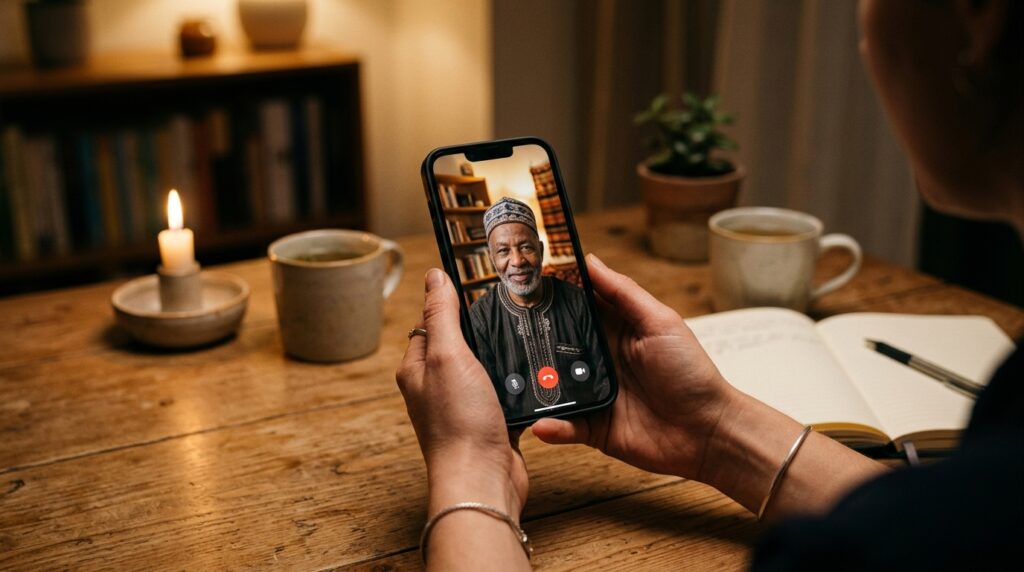
A good consultation leaves you clearer than you arrived, and free to say no.Baba Ali
What should you leave with?
You should leave with a clear idea of what the practitioner thinks, what they’d suggest, what it would cost and what happens next. Ideally you’ll have notes, written terms and a date to decide by, with no pressure to commit that day.
Check that you can answer these four questions after the call:
- What did they say about my situation, in plain words?
- What would they do, and how long would it take?
- What would it cost, item by item, and what’s the refund policy?
- What’s my next step, and by when do I need to decide?
If you can’t answer one, send a short message asking for clarification, or ask on a second call. A practitioner who answers clearly is easier to trust than one who dodges.
Also check how you feel. Do you feel calmer, clearer and respected? Or pressured, confused or small? Your feelings are information. If you left feeling worse than you arrived, it’s okay to say no.
Sleep on it. Talk to a friend. If you feel drawn to go ahead, compare the practitioner against the criteria in my guide on who is the best love spell caster in America. If you decide not to, thank them and move on.
What if you’re nervous or embarrassed?
Nerves are normal, and so is embarrassment. Almost everyone feels exposed when they explain a painful situation to a stranger. A good practitioner has heard it all, and they won’t judge you.
A few things help. Remind yourself that you’re in charge: you can pause, skip a question or end the call. Start with the facts, and let the feelings follow. Take a breath before you answer a hard question. Write the hardest sentence on a card before the call, so you can read it if the words won’t come.
If you cry, that’s all right. A good practitioner will wait. If you feel embarrassed about believing in this kind of help, remember that people have sought ritual support for love, loss and hope for as long as there have been people.
And if the nerves are overwhelming, move the conversation to another day. There’s no deadline that should push you into a call you aren’t ready for.

What if the practitioner advises against going ahead?
It’s a good sign, not a bad one. A practitioner who tells you the truth, even when it costs them the booking, is showing you who they are. Honest advice sometimes means “wait,” “see a counselor,” “this isn’t a good idea” or “I don’t think I can help.”
I’ve said all four to people. I’ve said “wait” to someone who was too raw to act, “see a counselor” to someone whose grief was overwhelming, “this isn’t a good idea” to someone who wanted to break up a couple, and “I can’t help” to someone whose situation was beyond ritual work.
If you receive advice like that, take it seriously, and don’t be tempted to shop for a practitioner who’ll say yes. People who keep asking until someone agrees tend to end up with the least careful help. If a second opinion agrees, you’ve learned something. If one disagrees, ask them why.
Also be wary of the opposite: a practitioner who says yes instantly to anything. If they’d do work for any aim, however harmful, they’re showing you how little they weigh the consequences.
How my free 30-minute consultation works
My consultation is a conversation, and it’s free. It lasts about thirty minutes. I ask about your situation, I listen, and I tell you what I honestly think. If I believe I can help, I explain what I’d do and what it would involve. If I don’t, I say so, and I point you to better help where I can.
I don’t promise outcomes on the call. I explain what the work can and can’t do. I don’t charge for the spiritual work. In my tradition it isn’t done, so the client covers only the materials needed for their specific situation, and I explain what each is for before any money moves. After any result, a gift of gratitude is up to you, never expected. The ritual work finishes within three to seven days, and what happens in your life runs on its own clock.
I don’t ask for gift cards, wires, ID documents or passwords. I don’t ask you to keep our work secret. And you can say no at any time, with no penalty. You can reach me by phone at (210) 651-2737, and a real person answers.
If you’d like to book, use the free consultation page, or read my page on how to book a love spell casting. You may also like my FAQ and my page on ethical practice. If you’d like to reach me first, the contact page has the details.
Ready for a plain conversation?
Bring your notes and your twelve questions, and ask anything. The first 30 minutes are free, there’s no obligation, and if any ritual work follows, you cover only the materials for your case.

What should you do after the consultation?
Write down what you remember while it’s fresh: what was said, what was offered, what felt right and what didn’t. Compare it with your list of questions. Check that you got an answer to each.
Then wait at least a day. Talk to a trusted friend and read your notes again. If you’re still drawn to go ahead, ask for the terms in writing, and read them carefully. If something has changed, or you feel uneasy, say so.
If you decide to proceed, set review dates at thirty and ninety days, and decide in advance how you’ll know whether to continue. If you decide not to, you’ve lost nothing, and you’ve learned how a good conversation feels. My guide on how to choose a love spell and my page on psychic readings before a love spell may help with the next step.
And look after yourself. A consultation can stir up feeling, and that’s natural. Eat, rest and spend time with people who care about you. If you feel low for days, talk to a doctor or counselor.
Should you speak to more than one practitioner?
Yes, if you can, and it’s one of the best protections you have. Talking to two or three practitioners lets you compare how each one listens, what each one says and how each one treats your questions. You’ll learn more from the contrast than from any single call.
Don’t treat it as a hunt for the answer you want. Treat it as a way to see the range. If two practitioners tell you the situation looks open and one says it looks closed, ask each why. If all three say wait, take that seriously. If one promises quick results and the rest don’t, ask what the first one knows that the others don’t, and be ready to hear that the answer is “nothing.”
Keep a simple comparison sheet. For each call, note the name, the date, how you felt, what they said they’d do, what they said they couldn’t do, what they asked you to pay and how they responded to “I need a day.” A glance at the sheet usually makes the choice clear.
Finally, never let anyone tell you that speaking to others will spoil the work. That’s a common line, and it exists to keep you from comparing. Honest practitioners welcome comparison, because they expect to hold up well.
Frequently asked questions
What happens in a spell caster consultation?
The practitioner asks about your situation, listens, tells you honestly what they think and explains any work, its limits, costs and timing. Nothing is cast during the call. It usually lasts thirty to sixty minutes, and you should leave with a clear plan, written terms and time to decide.
How should I prepare for a consultation?
Write a short summary of what happened, your hope in one sentence, what you’ve already tried, and your questions. Choose a quiet time, silence your phone and have a notebook ready. Decide in advance not to pay or commit during the call, and give yourself a day.
What questions will a spell caster ask me?
They’ll ask what happened, what you hope for, what you’ve tried, who else is involved, how you’re coping, whether you feel safe and what you’ll do if the answer is no. A good practitioner explains why they ask and lets you decline to answer.
What questions should I ask a spell caster?
Ask what they’ll do and how long it takes, what the work can’t do, whether they promise results, the total cost and refund policy, whether they do force or break-up work, what they’ll never ask of you, how long they’ve practiced and what happens if you say no.
Is a free consultation a good sign?
Usually. It lets you test the practitioner at no cost. It should be a real conversation, not a pitch. If a free call leads straight into pressure to pay, that’s a red flag. In my practice the first 30 minutes are free, with no obligation.
Will I be asked to pay during the call?
You shouldn’t be. A good practitioner gives you terms in writing and time to decide. Pressure to pay on the call, or a deadline measured in hours, is a warning sign. Ask for costs in writing and take a day.
What should a spell caster never ask me for?
Passwords, banking logins, ID documents, remote access to your devices, gift cards, wires or crypto, private details or belongings of other people, and a promise to keep things secret from your family. Any of those is a reason to end the conversation.
What if the spell caster says no or advises waiting?
That’s often a good sign. A practitioner who tells you the truth, even when it costs them the booking, shows integrity. Take the advice seriously, and don’t shop for someone who’ll say yes. A second opinion from a counselor can help too.
What if I’m too nervous to call?
That’s normal. Start with the facts, write your hardest sentence on a card, and remember you can pause or end the call. If the nerves are overwhelming, move it to another day. Nothing forces you to speak before you’re ready.
More Sacred Wisdom

Ready to Reunite With Your Soulmate?
If the signs are speaking to you, do not let the moment pass. Book a free consultation with Baba Ali today and discover the sacred path back to the love you deserve.