
When people search for a love spell caster near me, most assume proximity matters — that a practitioner across town is somehow more trustworthy than one working three states away. After 33 years of practice serving clients in every state, I can tell you directly: the ritual does not care about your zip code. What matters is whether the person you are trusting is legitimate, transparent, and actually skilled at the work. Location tells you none of that.
I understand why the instinct is there. A local business feels like something you could walk into and hold accountable if things went wrong. It feels safer to imagine a storefront, a face you could recognize on the street, a person you could theoretically confront. But spiritual work is not a service you drop off and pick up like a repair job, and the practitioners who lean hardest on “local” and “near you” in their marketing are often the ones with the least to show for their actual results. A polished local ad campaign is not evidence of skill. It is evidence of a marketing budget.
I have spent over three decades doing this work, and in that time I have watched the search behavior change even as the underlying problem stays the same. People type “love spell caster near me” into a search bar because they want reassurance, not because proximity actually predicts anything about outcomes. This guide walks through what to check instead of a map pin, so you can tell the difference between someone who does real work and someone who simply bought a good local SEO package and a stock photo of a candle.
It helps to remember that this search pattern is not unique to spiritual work. People search “near me” for restaurants, plumbers, and dentists too, and in those cases proximity genuinely matters because the service requires physical presence. Spellwork does not belong in that category, even though search habits do not know the difference. Once you separate the habit of typing “near me” from the actual requirements of the service you are looking for, the whole search opens up considerably, and so do your options for finding someone genuinely good at this.
Why “Near Me” Is the Wrong First Filter (Love Spell Caster Near Me)
Spiritual work operates on intention and connection, not physical distance. A “love spell caster near me” search often leads people to whoever has the flashiest local ad or the newest storefront, not whoever actually gets results. I have worked with clients in New York, Los Angeles, Houston, Chicago, and dozens of smaller cities in between, using the same private, consent-centered process regardless of where they happened to be sitting when we first talked. The zip code in their address never changed a single step of the work.
Think about how the work is actually done. A ritual involves candles, herbs, focused intention, and time set aside with your name and your situation in mind. None of that requires you in the room, and none of it requires me to be in your city either. The energy a practitioner raises during a working travels through connection and intention, not through a shared zip code. If physical presence mattered the way people instinctively assume it does, distance healers, remote intercessory prayer, and long-distance ancestral work would not have existed for centuries across cultures that predate the internet by a very long way. This is not a new idea dressed up for the digital age. It is an old idea that the internet finally made easy to search for.
What “near me” searches are really doing is filtering by convenience, not by competence. And convenience is a poor proxy for whether someone is honest, experienced, or good at what they do. A caster three time zones away who answers your questions directly, explains the process before asking for anything, and has been doing this for decades is a safer choice than a “local” listing that popped up two months ago with a stock photo and no real history behind it. I have talked to more than a few clients who tried the local route first, paid for a rushed session with someone they found through a map search, and came away with nothing but a receipt and no real explanation of what had actually happened.
There is also a practical reality worth naming directly: in most parts of the country, there simply are not many dedicated, experienced spiritual practitioners working within driving distance of the average person. Outside a handful of major metro areas, “near me” results are often thin, generic, or run by people with no real specialization in this kind of work at all. Insisting on proximity in a field this specialized usually means settling for whoever happens to be closest, not whoever is actually good.
What Actually Matters Instead of Location
I also want to be direct about something that “near me” searches tend to obscure entirely: reputation in this field is built slowly, over years of consistent, honest work, not over a few months of aggressive local advertising. A practitioner who has been doing this for three decades has a track record that a six-month-old listing simply cannot match, no matter how well-designed its website looks or how high it ranks for local search terms.
Once you set proximity aside, a short list of things actually tells you whether a practitioner is worth your time and your trust. None of them show up on a map. All of them show up if you ask the right questions before you commit to anything, and a legitimate practitioner will welcome those questions rather than dodge them.
I bring this up because I have had this exact conversation with clients who tried local options first. One client in a mid-sized city told me she interviewed three “local” practitioners before finding me, and every one of them either dodged her questions about training or pushed her toward an expensive package within the first five minutes. None of them offered a real conversation first. That pattern is common enough that I mention it explicitly here, because it is the clearest single warning sign across every situation I have heard about.
Verifiable Experience and Credentials

Anyone can put “spiritual advisor” in a bio overnight. Fewer people can point to a lineage, a training history, or a body of work that stretches back years rather than months. I have practiced for 33 years, trained within a West African spiritual tradition passed down through direct mentorship, and hold recognition through the African Native Healers Association. That is not a marketing badge I picked up for the website. It is a record of accountability to an actual practice and to a community of other practitioners who know my work and would recognize if I were misrepresenting it.
Ask any caster, local or remote, how long they have practiced, where they trained, and whether they can describe their tradition in specific, grounded terms rather than vague spiritual language borrowed from a dozen different traditions at once. Someone with real experience answers those questions without hesitating, because they have answered variations of them for years. Someone who is improvising will get vague, defensive, or suddenly evasive fast, and that reaction alone tells you more than any polished answer could. Pay close attention to the difference between confidence and specificity. Confidence is easy to fake. Specific, consistent detail is much harder to fabricate on the spot.
A Practitioner Willing to Talk Before You Pay Anything

A legitimate practitioner wants to understand your situation before anything else happens. That means a real conversation, not a rushed intake form and an immediate invoice waiting at the end of it. I offer a free consultation for exactly this reason: I need to hear the actual details of what you are dealing with, and you need a real chance to ask me anything before deciding whether this is a fit for you and your situation.
If a caster, local or remote, tries to skip this step and push you straight to payment, that is worth pausing on. Willingness to talk first is one of the clearest signals of legitimacy, because it costs the practitioner real time and gives you nothing to buy yet. Scammers do not want that exchange. They want the transaction closed before you have time to think it through, ask questions, or compare what you are hearing against what you already know about your own situation. A short, unhurried conversation, where the practitioner listens more than they sell, tells you almost everything you need to know before a single candle is lit.
Materials-Only Transparency
I do not charge for spiritual work itself. What clients cover are the actual materials involved in a ritual — candles, herbs, oils, and the other physical items a working requires. After results come through, clients sometimes choose to offer a free-will gratitude donation, but that is never required and never tied to a promised outcome. You can read a full, honest breakdown of how this works on the love spell cost page, including realistic ranges for different kinds of workings — a pattern Verywell Mind has documented as well. — a pattern Verywell Mind has documented as well.
This distinction matters more than it might seem at first glance, because it changes the incentive structure entirely. A practitioner charging a flat fee for “guaranteed results” is selling you a promise, not a process, and has every financial incentive to upsell you into a bigger package regardless of what your situation actually calls for. A practitioner asking you to cover materials and nothing more has no reason to inflate what a working actually costs, no reason to invent additional steps, and no reason to string you along for more payments once the ritual has already begun. Ask directly what the materials cost covers and what it does not. A clear, itemized answer is a good sign. A vague total with no explanation is not.
No Guaranteed-Outcome Claims
Anyone who tells you a love spell is guaranteed to work, on a fixed timeline, is telling you what you want to hear rather than the truth. Spiritual work deals with free will, timing, and forces that no honest practitioner controls completely. I have seen workings unfold in days and I have seen them take months, and I say that plainly to every client before we start, not after they have already paid for a promise that was never realistic in the first place.
Be skeptical of any caster, near or far, who uses words like “100% guaranteed,” “instant results,” or “money-back guarantee” for spiritual work. Those phrases are sales language borrowed from retail, and they do not belong in an honest description of ritual practice. Real spiritual work respects the fact that another person’s free will is involved, and that timing is genuinely unpredictable. A practitioner who acknowledges that uncertainty upfront is being honest with you. A practitioner who erases it entirely is telling you what closes the sale.
Consistent, Findable Contact Information
A real practitioner has a consistent name, a working phone number or email, and a history you can actually find — reviews, a website that has existed for more than a few weeks, a social presence that predates last month. Scam listings tend to rotate business names, use disposable phone numbers, and vanish the moment complaints start piling up against them. Before committing to anyone, search their name and business together and see what comes up. A thin or brand-new digital footprint is not automatically disqualifying, but combined with other red flags, it is worth taking seriously. You can learn more about my background and how I actually work on the about page.
What a Real Consultation Actually Covers
Since the consultation is the first real test of legitimacy, it helps to know what an honest one actually sounds like. When you reach out, I ask about your situation in plain terms: what has happened, what you are hoping for, and what you have already tried. I am listening for detail and context, not looking for an opening to sell you something bigger than you need.
From there, I explain what kind of working fits your situation, what it would involve, and what materials it requires. I am direct about timing expectations and I do not promise a specific outcome or a specific date. If your situation is not something spiritual work is well suited to address, I say that too, rather than taking a payment for something I do not believe will genuinely help you.
By the end of a real consultation, you should understand exactly what happens next, what it costs in materials, and why. If you finish a conversation with a practitioner and still cannot answer those three questions, that is worth treating as a signal, not an oversight on your part.
Red Flags That Hide Behind Local-Sounding Listings
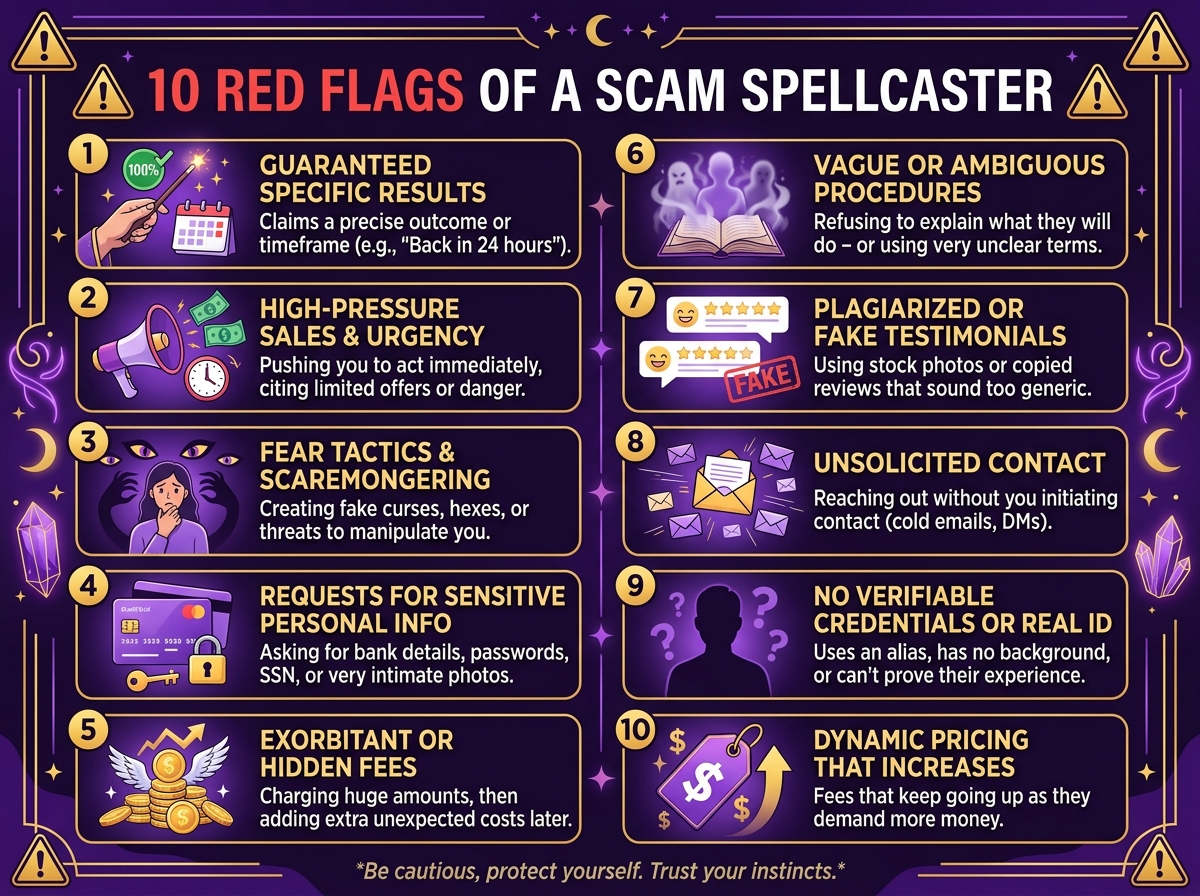
A local-sounding business name and a nearby address do not protect you from a scam. Some of the worst patterns I hear about from new clients came from “local” listings that turned out to be fronts with no real practice behind them at all, run by people who never actually met a client in person despite the local branding. A few patterns show up again and again, regardless of where the person claims to be based.
Pressure to decide immediately is the biggest one. If someone tells you the “window” for your working closes today, or that prices go up tomorrow, that urgency is manufactured to stop you from thinking clearly or comparing options. Real spiritual timing does not work on a sales countdown, and any practitioner who frames it that way is prioritizing your wallet over your wellbeing.
Refusal to explain the process is another common pattern. If you ask what a ritual actually involves and get a vague answer about “trusting the process” instead of specifics, that is a sign the person either does not know or does not want you to know how little is actually happening behind the scenes. A real practitioner can walk you through, in plain language, roughly what materials are involved and what the steps look like, without giving away anything that would compromise the work itself.
Escalating requests for money are a third pattern, and one of the more damaging ones. A working starts at one price, then suddenly needs a “block removal,” then a “curse cleanse,” then a “final release payment,” each one framed as newly discovered and each one more expensive than the last. Legitimate materials costs do not multiply indefinitely once a working has already begun. If the number keeps climbing after you have already paid, that is not spiritual necessity. That is a script.
Fabricated urgency around a rival or a curse is a fourth pattern worth naming specifically. Being told that someone has “put something” on your relationship, and that only an expensive counter-working can fix it, is one of the oldest manipulation scripts in this field. It preys on fear rather than on any real diagnosis. Approach any claim like that with real skepticism, whether the person making it is across town or across the country, and ask them to explain, specifically and without vague mysticism, how they arrived at that conclusion.
How Remote Spellwork Actually Works

Once you take location out of the equation, the actual mechanics of the work are simple and worth walking through plainly, because uncertainty about the process is usually what makes people default back to wanting someone local. We talk, usually by phone or a written consultation, about your situation, your intention, and what you are actually hoping for. I explain what a working for your specific circumstances involves, what materials it requires, and roughly what to expect in terms of timing, so you are never left guessing at what is happening or why.
From there, the ritual itself happens on my end, using your name, your intention, and the materials the working calls for. Distance does not weaken any part of that process, because the work was never dependent on shared physical space to begin with. I go into much more depth on how this works, and how distance changes the practical shape of a working without changing its effectiveness, in this guide to love spells for long-distance relationships, which covers the mechanics in more detail than fits here.
Clients in rural areas, small towns, or cities with no dedicated spiritual practitioner nearby often assume they are stuck with whatever they can find locally, or nothing at all. That is not true, and it has not been true for a long time. Remote work with an experienced practitioner is not a fallback option or a lesser substitute for the “real thing.” For most people searching for a love spell caster near me, it is simply the more realistic and often the better path, because it opens the search up to practitioners with real experience instead of narrowing it down to whoever happens to have an office within driving distance.
People sometimes ask whether video calls or phone calls change the effectiveness of a working, as though a screen adds some kind of barrier that in-person contact would not have. It does not. The consultation, whatever form it takes, is about gathering accurate information and building a clear intention, not about transmitting spiritual energy through the call itself. The actual working happens separately, on my end, once I have everything I need from our conversation.
A Practical Checklist for Vetting Any Caster

Whether you are looking locally or considering someone remote, the same short checklist applies. Before you commit anything — your money, your details, or your trust — confirm the following about the practitioner you are considering.
- They offer a real conversation before any payment, not just an intake form.
- They can describe their training, tradition, and years of experience in specific terms, not vague spiritual language.
- They charge for materials, not for the ritual itself, and explain that distinction clearly when asked.
- They never promise a guaranteed outcome or a fixed timeline for results.
- They have consistent contact information and a history you can actually verify.
- They do not pressure you with artificial urgency, fear, or claims about curses you need to pay to remove.
- They answer direct questions directly, without dodging, deflecting, or getting defensive.
If a practitioner passes all seven, distance stops being a meaningful factor either way, because everything that actually determines whether the work is trustworthy has already checked out. If they fail even one or two of these, the fact that their office sits fifteen minutes from your house will not save you from a bad experience. Print this list, or save it somewhere, and run through it before your next consultation with anyone, myself included.
None of this means every remote practitioner is trustworthy by default, any more than every local one is a scam. The point is not that distance makes someone good. The point is that distance tells you nothing either way, and the checklist above is what actually separates a legitimate practitioner from someone who is not, regardless of where they happen to be.
Frequently Asked Questions
Does it matter if a love spell caster lives in my city?
No. The mechanics of a ritual do not depend on shared physical space. What matters is the practitioner’s honesty, experience, and process, none of which are tied to geography in any real way.
How do I know a remote practitioner is real and not a scam?
Look for the same signals you would want locally: a real conversation before payment, verifiable experience, materials-only pricing, no guaranteed-outcome claims, and consistent, findable contact information. A remote practitioner who offers all of that is a far safer choice than a local one who offers none of it.
Do I need to send a photo or personal item for remote spellwork?
It depends on the specific working, and I will tell you exactly what is needed, if anything, during your consultation. I never ask for more than a particular ritual actually calls for, and I explain why each item is needed if you ask.
How much does a love spell cost if I work with someone remotely?
The same as it would locally: you cover the cost of materials, not a flat fee for the ritual itself. The full breakdown is on the cost page, and I will walk through your specific situation and a realistic range during a free consultation.
How long does remote spellwork take to show results?
There is no fixed timeline, locally or remotely. I have seen situations shift within days and others take months, depending on the people, history, and circumstances involved. Anyone who gives you an exact countdown to the day is guessing, not practicing.
Can I see proof that other clients have had real results?
I share honest accounts of past client situations, without fabricated numbers or manufactured reviews, in the case studies I have published. I would rather show specific, real situations than generic five-star claims that could belong to anyone.
What if there really is no experienced spell caster near me at all?
That is a common and reasonable situation, especially outside major cities. It does not mean you have to settle for someone unqualified nearby or go without help entirely. Remote work with a practitioner whose experience and process check out is a legitimate, often better option than settling for proximity alone.
Choose the Practitioner, Not the Pin on the Map
“Near me” is a convenient filter, but it is not an honest one. It tells you nothing about whether a practitioner is experienced, transparent, or trustworthy, and it can just as easily lead you to someone who invested in local ads rather than real skill and real years of practice. Use the checklist above instead: a real conversation first, verifiable experience, materials-only costs, no guaranteed outcomes, and consistent, findable contact information. Those five things tell you far more than a distance filter ever could.
If you want to talk through your specific situation before deciding anything, I offer a free consultation. There is no pressure and no cost to have that conversation — just a chance to ask your questions directly and decide for yourself whether this is the right fit, regardless of how many miles happen to sit between us.




Leave a Reply