
Connecting With Ancestors for Love Guidance
A Senegalese spiritual practitioner’s honest guide to asking your ancestors for love guidance — a simple altar, the signs they answer with, and how to listen without demanding.
Your ancestors want you happy and partnered, and connecting with them for guidance on your love life is far simpler than most people assume — it does not require a special gift, a rare object, or years of training. It requires a quiet corner, a lit candle, and honesty about what you actually want to ask. In my grandmother’s house, this was not a special occasion. It was Tuesday. Ancestor connection was as ordinary as boiling water for tea, and it was one of the first things she taught me, long before she taught me anything about love spells at all.
I am Baba Ali. I was raised in a Senegalese household by my grandmother, Aminata, in the Serer and Wolof traditions of ancestral guidance, and I have spent more than thirty years since then helping people in this country reconnect with their own family lines for exactly the kind of guidance this article describes. Over that time I have worked with more than 5,000 clients, but the practice I am about to teach you does not require me at all. It requires you, a little patience, and a willingness to believe that the people who loved you before are still paying attention.
Before You Read Further
Ancestor guidance is not fortune-telling and it is not a substitute for your own judgment. What it offers is perspective — the view of someone who loved you unconditionally and has no stake in your ego, your fear, or your pride. Treat it that way, and it will serve you well.

Connecting With Ancestors For Love Guidance: Why Ancestors Care About Your Love Life
The direct answer is that your love life is the mechanism through which your family line continues, and in the tradition I was raised in, that continuation is something the deceased remain invested in long after they leave the body. My grandmother used to say that death changes an ancestor’s address, not their household. They do not stop being your grandmother, your uncle, your great-aunt, simply because they are no longer sitting at the table. They watch the table from somewhere close by, and the empty chair across from you gets their attention as much as anything else in your life does.
This is not a metaphor I use loosely. In Serer and Wolof ancestral practice, the dead who are properly honored become active participants in the family’s ongoing story rather than closed chapters of it. A grandmother who worried about her granddaughter’s choice in men while alive does not, in this understanding, simply stop worrying because she has passed. She watches for the same patterns. She notices the same warning signs. And she has, if anything, a clearer vantage point than she had in life, because she is no longer inside the day-to-day noise that clouds a living person’s judgment.
There is a second, more practical reason ancestors take an interest in a descendant’s love life specifically. In this tradition, a healthy line depends on healthy unions. An ancestor who fought hard to build something, a marriage, a household, a name that carried weight in the community, has a natural investment in seeing that effort carried forward rather than repeated badly or lost. When I sit with clients whose romantic patterns keep breaking in the same place, generation after generation, I often find an ancestor trying to interrupt the pattern rather than cause it. The guidance, when it comes, tends to point toward what needs to change, not blame for what went wrong.
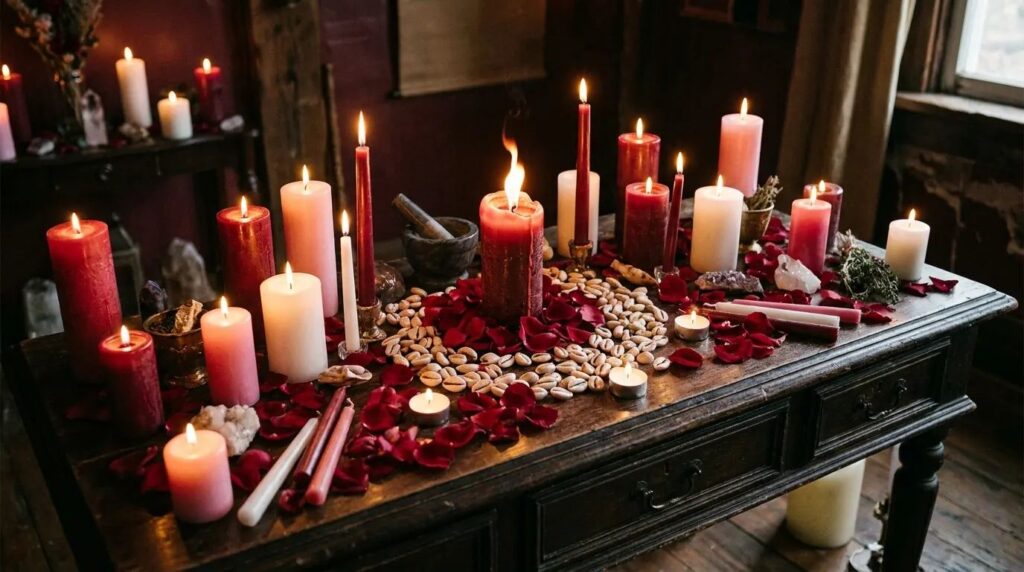
How to Set Up a Simple Home Ancestor Altar
You do not need a special room, imported items, or anyone’s permission. What you need is a small, consistent space that your family line recognizes as theirs, and a habit of returning to it. Here is exactly how I walk a client through building one for the first time.
01Choose a Quiet Corner
Pick a spot that is low-traffic and calm, a shelf, a small table, a windowsill, somewhere you will not be rushed past on your way to somewhere else. It does not need to face any particular direction. What matters more is that it stays undisturbed, so choose somewhere out of a child’s reach or a pet’s path if that is a concern in your home.
02Add Photos or Represented Items
If you have a photograph of a deceased relative, place it there. If you don’t, an object connected to them works just as well, a piece of jewelry, a handwritten letter, even an item from a place they loved. If you have no photos or objects at all, a small piece of paper with their name written on it, or simply the words “my grandmothers” or “my family line,” is a complete and honest substitute.
03Light a White or Gold Candle
White and gold both carry clarity and welcome in this tradition. Light the candle when you sit at the altar and let it burn while you are present, then extinguish it rather than leaving it unattended. A simple votive is fine. This is not about the size of the flame.
04Speak Your Intention Aloud
Say what you are there for, out loud, even if it feels strange the first few times. “I am here to ask for guidance about my relationship with [name], or about finding a partner who is right for me.” Speaking it aloud rather than only thinking it matters in this tradition. A thought can drift. A spoken word settles the room.
05Listen and Journal What Comes
Sit quietly for a few minutes afterward. You are not waiting for a voice, though some people do describe something like one. You are watching for a feeling, a memory that surfaces unprompted, a sudden clarity about a decision you had been avoiding. Write it down immediately, even a fragment, because these impressions fade quickly once the ordinary day resumes around you.
Ten minutes, two or three times a week, is enough to build a working relationship with this practice. I have had clients who expected something dramatic the first time and were disappointed when nothing happened. This is not usually how it works. The first few visits often build the channel rather than deliver the message. Guidance tends to arrive once the habit is established, not before.
Signs an Ancestor Is Trying to Communicate About a Relationship Matter
Ancestors rarely announce themselves with anything as clean as a full sentence. In my experience, and in what my grandmother taught me to watch for, the communication is subtler and more patterned than people expect, which is exactly why it gets missed so often. Here is what I ask clients to pay attention to specifically when the question on the table is love or relationship.
Dreams featuring a deceased relative are the clearest and most commonly reported sign. Not any dream, a specific quality of dream: unusually vivid, often set somewhere ordinary like a kitchen or a hallway rather than somewhere fantastical, and leaving a distinct emotional residue that lingers into the morning. If your grandmother appears in a dream the same week you are agonizing over whether to end a relationship, that timing is not incidental in this tradition. Write the dream down as soon as you wake, before the details soften.
A specific song or memory surfacing repeatedly is the second sign, and it is one people dismiss most often because it looks like coincidence. If a song your late father used to hum keeps playing in stores, on the radio, in a stranger’s car with the window down, three or four times in a short span, that is worth noting rather than shrugging off. The same goes for a sudden, unbidden memory of a specific piece of advice a grandmother once gave about relationships, surfacing at exactly the moment you need to hear it again.
A sudden strong intuition is the third sign, and the hardest to describe cleanly because it does not always come with an image or a memory attached. It arrives as a certainty that seems to come from outside your usual thought process, a clear “leave” or “stay” or “wait” that feels less like your own reasoning and more like it was handed to you. Clients describe it as a settling rather than a conclusion they worked toward. When that certainty follows a session at the altar, I take it seriously.
| What You Might Notice | What It Often Signals |
|---|---|
| A vivid dream featuring a deceased relative | Direct communication, especially near a decision point |
| A specific song or memory repeating unprompted | An ancestor pointing your attention toward something |
| A sudden, unexplained certainty about a choice | Guidance arriving as intuition rather than words |
| A physical object of theirs catching your eye repeatedly | An invitation to sit at the altar and ask directly |
| An unusual calm after a difficult decision | A sign the guidance has already been received and settled |
A grandmother does not stop worrying about you when she leaves the room. She simply learns to worry more quietly. — A saying my grandmother Aminata used often
How to Ask for Guidance Without Demanding
The tone of the request matters as much as the practice itself. I have watched people build a beautiful altar and then treat it like a vending machine, demanding a specific answer on a specific timeline, and wondering why the guidance feels muddy or absent. Ancestors, in this tradition, respond to respect and patience the way anyone would. Demand something from a grandmother and she goes quiet. Ask her honestly, and she tends to answer.
Frame your question as an actual question, not a request for permission to do what you have already decided. “Should I stay in this relationship?” is honest. “Please tell me it’s fine to stay” is not a question, it is a plea dressed up as one, and it rarely produces clear guidance because it is not actually open to an answer you might not want. The clearest results I have seen come from clients who genuinely did not know what they wanted to hear before they sat down at the altar.
Give the guidance time to arrive rather than expecting it in the same sitting. Some answers come within the hour, as a dream that night or a wave of clarity before bed. Others take days or even a couple of weeks, arriving through the signs described above rather than through the altar session itself. Sitting at the altar every single day demanding a faster answer does not speed this up. If anything, it tends to muddy the signal, the same way shouting a question at someone who is already listening carefully does not help them hear you better.
Say thank you, every time, whether or not you feel you received anything. This is not a courtesy for its own sake. In this tradition, gratitude is part of what keeps the channel open for the next time you need it. My grandmother never once let me leave that corner of the house without a word of thanks, regardless of what had or had not happened in the sitting.
Want Support Reading What You’re Receiving?
If you’ve started this practice and are unsure how to interpret what’s coming through, or if a relationship matter feels tangled enough that you want a second, trained perspective, a reading can help clarify what your line is trying to tell you.
What to Do If You Don’t Know Your Ancestors or Have a Complicated Family History
This question comes up in nearly every consultation I do on this subject, and I want to answer it as directly as I can: not knowing your bloodline, or having a family history marked by estrangement, adoption, abuse, or loss of records, does not shut this door. It changes the shape of the practice, but it does not close it.
In Serer and Wolof tradition, ancestral connection is not limited strictly to the people whose names you can trace on a chart. There is a wider understanding of lineage that includes what I call universal ancestral connection, the accumulated wisdom and protection of those who came before any of us, reachable even without a single known name or photograph. If you do not know your grandmother’s name, you can still light a candle and say, honestly, “I am asking for guidance from whoever in my line loved and wanted good things for the people who came after them.” That request is complete. It does not need a name attached to be heard.
For clients with a genuinely painful family history, people whose living relatives caused real harm, I make an important distinction. Ancestral guidance is not about reconnecting with the specific personalities of people who hurt you. It is about the protective, loving current that exists somewhere further back in most lines, even difficult ones, an aunt three generations removed, a great-grandmother you never met who broke a hard pattern in her own life. You are not obligated to invite anyone specific into that quiet corner. You are simply opening a door to whoever in your line genuinely wants to help, and closing it to whoever does not belong there. That boundary is yours to set, and setting it does not weaken the practice.
Respecting the Practice If You’re Not From This Tradition
People sometimes ask me, carefully and respectfully, whether it is appropriate to try ancestor connection if they were not raised in a culture that practices it formally. My honest answer is that this is not a closed practice in the way some spiritual traditions are. Speaking to your own dead, in your own words, asking your own grandmother for guidance about your own life, is not something you need permission to do, because they are your ancestors, not mine. What I am teaching you here is a structure and a respect for the process, not a system that only belongs to one culture.
What matters more than your cultural background is your sincerity and your care in how you approach it. Do not perform the aesthetics of a tradition you do not understand for the sake of appearance. You do not need African-specific items, Yoruba or Vodoun terminology, or anything borrowed from a specific closed lineage you have no connection to. You need your own photographs, your own memories, your own honest words spoken to your own dead. That is not appropriation. That is simply what ancestor connection has always been, in every culture that has ever practiced it, because every culture that has ever had grandmothers has had some version of this exact quiet-corner conversation.
Why Grandmothers Show Up First
In my own practice, and in the pattern I have watched across thousands of client sittings, grandmothers intervene in love matters more often and more directly than any other ancestor. There is a reason for this that goes beyond sentiment. A grandmother, in most family lines, holds the longest unbroken memory of the family’s romantic history, who married well, who married badly, which patterns repeated and which ones finally broke. She has, in life, usually already watched at least one generation make the same mistake twice. Her investment in interrupting it a third time runs deep.
My own grandmother Aminata told me once that the dead do their best work quietly, in the small hours, through dreams and sudden feelings rather than dramatic signs, because loud interventions frighten the living more than they help them. She said a grandmother’s guidance about love in particular tends to arrive as a feeling of being steadied rather than a feeling of being told what to do. If you sit at your altar asking about a relationship and what comes back is not an answer but a sense of calm you did not have before you sat down, that calm is very often the answer itself, arriving in the only form a grandmother tends to send it.

The Patience This Work Requires
I want to close the practical part of this guide with something honest rather than encouraging: this practice rewards patience more than any other spiritual work I teach, and it punishes impatience more visibly too. People who treat the altar as a once-a-month emergency hotline, lighting a candle only in crisis and ignoring it otherwise, tend to report the faintest, least reliable guidance. People who build the habit steadily, two or three quiet sittings a week regardless of whether anything is currently wrong, report the clearest and most consistent connection.
This mirrors ordinary relationships in a way I think is worth sitting with. You would not expect a grandmother you never called to suddenly have detailed, reliable advice for you the one week you finally needed her. The relationship has to exist before the guidance flows easily through it. Build the habit when things are calm, and it will be there, already open, when things are not.
Sources and further reading
- EBSCO Research Starters: Veneration of the Dead (Ancestor Worship): How cultures, including many in Africa, honor ancestors through ritual and offerings
- EBSCO Research Starters: Senegal: Overview of Senegal, including its main ethnic groups such as the Wolof and Serer
- NFPA: Safety with Candles: Candle fire facts and tips, such as keeping candles 12 inches from anything that burns
Frequently Asked Questions
How long does it take before I notice guidance coming through?
Some people notice something within the first week or two, usually a dream or a strong intuition. For most people, a consistent connection builds over four to six weeks of regular sittings. I encourage patience rather than expecting an immediate result.
Do I need a photograph to do this practice?
No. A written name, a remembered object, or simply an honest spoken address to “my line” or “my grandmothers” is a complete substitute if you have no photographs available.
Can this replace a reading with a practitioner?
It can be a full practice on its own for many people. Some clients come to me when they want a trained second perspective on what they are receiving, particularly with a tangled relationship matter, but the home altar practice itself does not require professional involvement to work.
What if the guidance I receive contradicts what I want to hear?
That is often the most trustworthy kind of guidance, precisely because it is not simply echoing your own wish back to you. I encourage clients to sit with uncomfortable guidance for a few days rather than dismissing it immediately.
Is it safe to do this without any training?
Yes. This is a gentle, low-risk practice rooted in respect and honest communication rather than in any kind of invocation that requires training to perform safely. It is closer to prayer than to ritual work.
What if I feel nothing at all after weeks of trying?
This happens, and it is usually not a sign of failure so much as a sign the channel needs more time, or that the current emotional noise in your life is drowning out a quieter signal. A brief cleansing practice before sitting at the altar often helps. Spiritual cleansing before love work clears the same kind of static that can dull ancestral connection.
How often should I visit my ancestor altar once it’s set up?
There’s no fixed schedule that makes it more effective. Some people light a candle daily, others visit weekly or only when they specifically need guidance. What matters more than frequency is consistency of intention — showing up occasionally with real attention beats a daily habit that has become empty routine.
Can I combine this with therapy?
Yes. If what surfaces feels more like unprocessed grief than guidance, that’s worth honoring on its own terms — this practice sits comfortably alongside therapy or grief counseling, and many clients do both.
A Final Word From Baba Ali
My grandmother sat at her own small altar most mornings of her life, long before I understood what she was doing there, and she kept sitting there right up until the year she became the photograph on someone else’s. I think about that often. The practice does not end when you become the ancestor. It simply changes which side of the candlelight you are standing on. That continuity is, to me, the whole point of this work: love guidance from the other side is not a strange or distant thing. It is a family conversation that has been going on longer than any of us have been alive, and you are welcome to sit down and join it whenever you are ready.
Start small. A corner, a candle, an honest question. Give it weeks, not days, before you judge whether it is working. And if you ever want a trained second set of eyes on what is coming through, particularly around a relationship decision that feels bigger than you can weigh alone, I am here, and the first conversation costs nothing but your honesty. If you would like to go further into the wider tradition this practice comes from, West African love magic and its history is a useful next read, and if a relationship pattern keeps repeating in your line, how to attract your soulmate pairs naturally with the guidance an ancestor sitting can offer.
More Sacred Wisdom


Ready to Reunite With Your Soulmate?
If the signs are speaking to you, do not let the moment pass. Book a free consultation with Baba Ali today and discover the sacred path back to the love you deserve.
Before You Sit at the Altar
If grief for the ancestor themselves is still raw, take a moment to settle your breathing first. This practice works best from a steady place, not straight from a wave of emotion.
When Grief Needs More Than a Ritual
If sitting with a deceased relative’s memory brings up grief that feels unresolved or overwhelming, a grief counselor is a valuable companion alongside this practice, not a replacement for it.