
If you’ve ever had a run of bad luck that made no sense — money slipping through your fingers, a relationship souring for no clear reason, a heaviness that follows you from room to room — you’ve probably heard someone say “sounds like the evil eye.” I’ve heard it too, in a dozen languages, from clients in a dozen countries. In over 33 years of spiritual work, I’ve sat with people from West Africa, the Mediterranean, the Middle East, the Caribbean, and the American South who all describe the same thing in different words: a sense that someone’s envy, spoken or not, has attached itself to their life. This begins with evil eye protection spell.
I want to talk about the evil eye honestly. Not as a guaranteed diagnosis for every bad week, and not as something I can wave away with a single candle and a promise. It’s a real tradition, carried by real families across real generations, and it deserves to be treated with the same care I’d give any other part of someone’s spiritual life. This is what I’ve learned about it, what I watch for, and what I do to help.
What the Evil Eye Actually Is (Evil Eye Protection Spell)
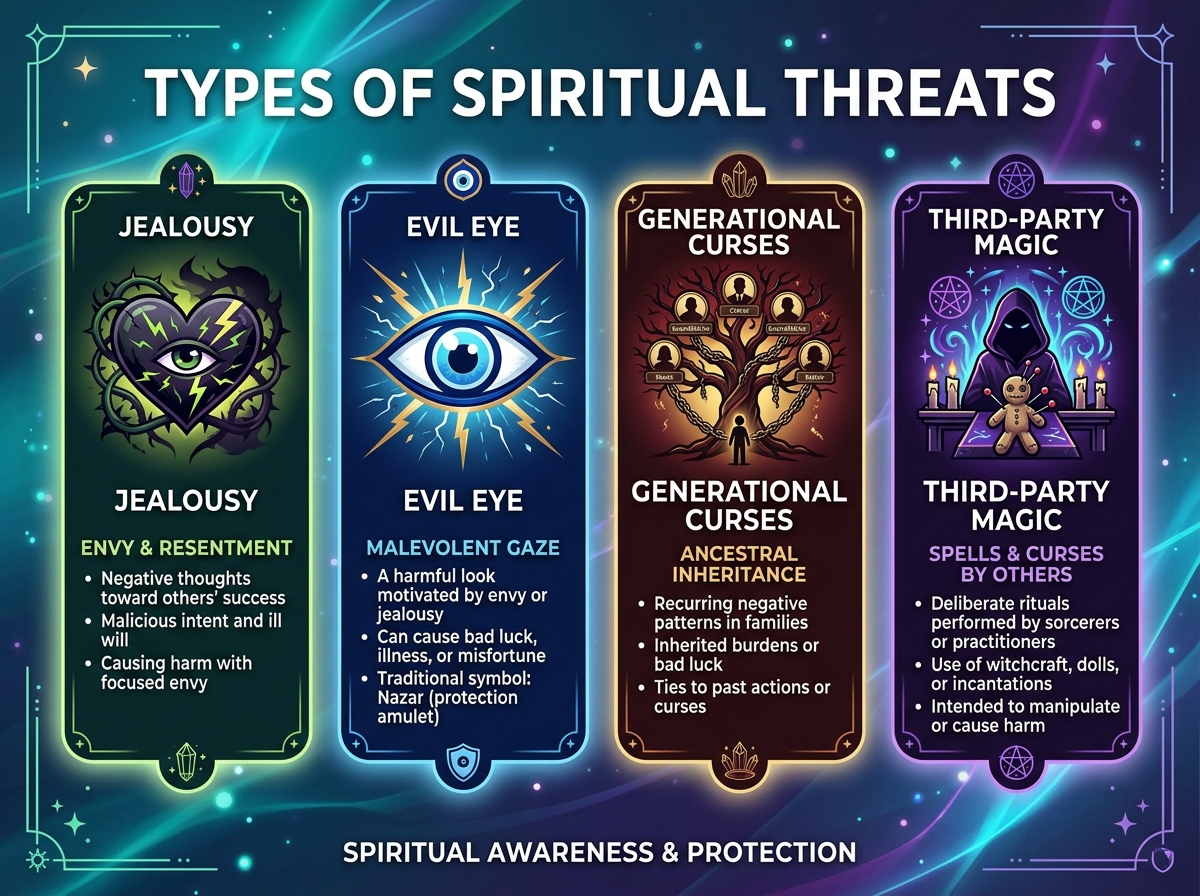
The belief is old — older than any single religion or region can claim. At its core, the evil eye is the idea that concentrated envy, admiration, or ill will directed at a person, without even needing to be spoken aloud, can affect that person’s luck, health, or relationships. It’s not usually framed as a curse someone deliberately casts. More often it’s described as something that happens almost by accident, when someone looks at your good fortune — a new baby, a new love, a new job — with a mix of admiration and resentment.
Across West Africa, where I trained, elders speak of “the heavy look” and pass down cleansing rituals using water, herbs, and prayer that have been in families for generations. In Mediterranean cultures — Greek, Italian, Turkish — you’ll see the blue glass eye charm, the nazar, hanging in doorways and worn as jewelry. In the Middle East and South Asia, black thread, alum stones, and specific prayers are used the same way. Latin American traditions have “mal de ojo,” often tied to admiring a baby too openly without touching it first. The details change. The underlying instinct doesn’t: strong attention, especially envious attention, is something people have felt the need to protect against for thousands of years.
I bring up these different traditions not to blend them into one thing, but to show you that this isn’t a fringe belief invented to sell candles. It’s one of the most widespread folk beliefs in human history, and it survived because generations of ordinary people felt it explained something real in their lives.
What strikes me most, after decades of doing this work, is how consistent the underlying logic is even when the surface details differ wildly. A grandmother in Lagos and a grandmother in Athens who have never met and share no language will still tell you the same basic thing: don’t stare too long at someone else’s blessing, don’t let your own good fortune go unprotected when it’s on display, and take it seriously when a string of bad luck starts right after a moment everyone was watching you. That kind of convergence, across cultures with no contact for most of history, is part of why I don’t dismiss this tradition the way some modern skeptics do. It’s also why I’m careful not to oversell it — a belief being old and widespread doesn’t make it the answer to every problem someone brings me.
In my own training, the emphasis was less on fear of other people and more on maintaining your own spiritual hygiene — the practices that keep you resilient regardless of what anyone else’s envy is doing. That framing matters. The goal isn’t to become suspicious of everyone who compliments you. It’s to build habits that keep your own energy clear, the same way you’d wash your hands without assuming every doorknob is contaminated.
Common Signs People Associate With the Evil Eye
I want to be careful here, because this is where a lot of spiritual sites get sloppy and start making medical claims they have no business making. I am not a doctor. If you are dealing with real physical symptoms, exhaustion that won’t lift, or a mental health concern, please see a licensed professional first. What I’m describing below are patterns my clients report and patterns their grandmothers taught them to watch for — folk signs, not diagnoses.
A Sudden, Unexplained Run of Bad Luck
This is the one people mention most. Everything was fine, and then within a short window — sometimes a single week — several unrelated things go wrong at once. A car breaks down, a deal falls through, a pipe bursts. Individually these are just life. Together, and especially right after a period of visible good fortune, people start to wonder.
Chronic Fatigue or a Sense of Heaviness
Clients describe waking up tired no matter how much they slept, or feeling like they’re moving through mud during the day. Again — rule out the physical causes first. But in the folk tradition, this “heaviness” is one of the classic markers, especially when it starts abruptly rather than building slowly.
Relationships Souring Without a Clear Reason
A partner who was warm suddenly turns cold. A close friend starts picking fights out of nowhere. Arguments erupt over nothing and escalate too fast. When there’s no real triggering event and the shift feels sudden and out of character, people in these traditions often point to outside envy rather than something broken inside the relationship itself.
Repeated Setbacks Right After Good News
You get the promotion, announce the engagement, or buy the house — and almost immediately, something goes wrong. This timing is a big part of why the evil eye belief persists. It isn’t random misfortune people are reacting to; it’s misfortune that shows up right on the heels of visibility and celebration, which is exactly when envy is most likely to be directed at you.
Children or Babies Becoming Unusually Fussy After Attention
In several traditions, babies are considered especially vulnerable, since they draw admiration easily. Parents notice a baby becoming inconsolable, sleeping poorly, or seeming “off” after being fussed over by a stranger or even a well-meaning relative. It’s one of the oldest reasons the blue eye charm exists — to protect the most vulnerable member of the household.
Money Moving Strangely
Not just tight finances — plenty of people go through lean months for perfectly ordinary reasons. What clients describe here is stranger: money that was expected simply doesn’t arrive, a deal that was essentially done falls apart at the last signature, or unplanned expenses appear from several directions at once, right after a period where finances were visibly improving. The pattern people point to is the whiplash — doing well enough that others noticed, then a sudden reversal that doesn’t track with anything either partner in the deal actually did wrong.
A Persistent Feeling of Being Watched or Unsettled
This one is harder to describe and I take it the most cautiously, because it overlaps with ordinary anxiety and stress. But some clients describe a specific, low-grade unease that started at a traceable moment — after a particular conversation, a particular visit, a particular photo posted online — rather than building gradually the way stress usually does. If you can point to the moment it started, that specificity is worth paying attention to.
None of these signs are proof of anything on their own. What matters is the pattern, the timing, and whether it lines up with a specific moment of exposure — a compliment that felt strange, a look that lingered too long, a person whose reaction to your good news didn’t sit right with you.
When It’s Probably Not the Evil Eye
I think this section matters as much as anything else on this page, because I’ve had clients come to me convinced they were dealing with spiritual attack when what they actually needed was a doctor, a therapist, or an honest conversation with the person they were fighting with. A few things that, in my experience, usually point away from the evil eye and toward something more ordinary: — a pattern Psychology Today has documented as well.
- Symptoms that built up gradually over months rather than appearing suddenly — that pattern fits burnout, overwork, or an underlying health issue better than a sudden spiritual cause.
- Bad luck that’s actually explainable once you look closely — a financial setback that traces back to a decision you made, a relationship strain that traces back to a real unresolved argument.
- Problems that are affecting everyone around you equally, not just you — a citywide economic downturn or a stressful season at a shared workplace isn’t envy directed at one person.
- Physical symptoms with no emotional or situational trigger attached — these deserve a medical opinion first, full stop, before any spiritual explanation is considered.
I’d rather tell a client honestly that their situation doesn’t fit this tradition than take on work that isn’t going to address the real problem. That’s part of what a direct conversation is for.
Protective Materials and Ritual Approaches
Once someone comes to me with this concern, we don’t jump straight to a ritual. We talk it through first — what happened, when it started, who was around. From there, protective work in this tradition tends to lean on a handful of materials that show up again and again across cultures, because they were trusted for generations before either of us was born.
The Blue Eye Talisman
The nazar boncuğu, or blue eye bead, is probably the most recognized protective symbol in the world at this point. The idea is simple: the eye “reflects” the envious gaze back rather than absorbing it. I recommend clients keep one near the front door, in the car, or worn close to the body — not as decoration, but as something they’ve consciously blessed and set an intention over.
Salt
Salt shows up in nearly every protective tradition I’ve studied, West African and otherwise. It’s used to cleanse a threshold, placed in the corners of a room, or dissolved in water for a floor wash. There’s something almost universal about salt as a boundary marker — it draws a line that unwanted energy isn’t meant to cross.
Cleansing With Herbs and Smoke
Depending on the tradition, this might mean sage, herbal bundles, or a wash prepared from specific plants passed down through family lines. The point isn’t the specific plant so much as the intention and the ritual of moving through a space — or over a person — clearing what’s settled there.
Candle Work
White candles are the most common choice for protection work, representing clarity and a clean slate. I use candle work to mark the start and close of a protective ritual, and sometimes to hold a longer intention over several days when someone is going through a rough patch.
Water and Alum
In several Mediterranean and Middle Eastern traditions, a piece of alum stone is heated and read almost like tea leaves — the shapes it forms when it burns are said to reveal whether envy has attached itself to a person. Whether or not you put stock in the reading itself, the follow-up ritual — washing with the water afterward — is a cleansing practice that shows up independently in cultures that never had contact with each other, which is part of why I take it seriously as a tradition even when I don’t treat it as literal fortune-telling.
Red Thread and Knotwork
A length of red thread, tied with a specific number of knots while holding an intention, appears across Jewish, Middle Eastern, and Central Asian protective customs. It’s worn on the wrist and replaced periodically. I like this one for clients who want something quiet and wearable — not everyone wants a visible charm hanging by their door.
Mirrors
Small mirrors, sometimes worked directly into amulets or hung near an entryway, follow the same logic as the blue eye — the idea that an envious look is more effectively deflected than absorbed. You’ll see this in Chinese Bagua mirrors, in Middle Eastern mirror-work amulets, and in older European folk charms placed above doorframes.
A Simple Protective Ritual You Can Do at Home
This is a basic version of what I sometimes walk clients through as a starting point. It’s not a replacement for a full reading or personalized ritual work, but it’s grounded in the same materials and intention I use in my own practice, and it’s safe to do on your own.
- Set the space. Choose a quiet moment when you won’t be interrupted. Open a window if you can.
- Light a white candle. As you light it, say plainly, in your own words, that you’re asking for protection and clarity — no need for elaborate language, just honesty.
- Take a pinch of salt. Hold it in your hand for a moment, then sprinkle a small line of it across your front doorway or windowsill.
- Cleanse the main room of your home. Walk through slowly with your herb bundle or smoke, moving from the front door inward, paying extra attention to corners where energy tends to collect.
- Close with gratitude. Thank whatever you pray to or believe in, let the candle burn down safely, and go about your day without dwelling on it further.
Do this once, and if things feel lighter, that’s worth paying attention to. If the same pattern keeps returning, that’s usually the point where I’d want to sit down with someone directly rather than have them keep repeating a home ritual on their own.
A few practical notes I give clients who try this on their own. First, timing matters less than most people assume — you don’t need a specific moon phase or a specific day of the week for a basic protective ritual like this one. What matters more is that you’re not rushing through it distracted. Second, if you share a home with other people, it’s worth doing this with their knowledge, even if they don’t participate, since a protective ritual in a shared space works best when it isn’t a secret. Third, don’t repeat this daily out of anxiety. Once, done properly and with intention, is more effective than five rushed attempts in a week — and doing it obsessively is usually a sign the underlying worry needs a real conversation, not another candle.

When It’s Tied to Relationship Problems
This is where evil eye work and love spell work overlap more than people expect. A large number of the clients who come to me convinced they’re dealing with the evil eye are really describing a relationship that changed direction suddenly — a partner who pulled away, a marriage that went cold, a new attraction that appeared out of nowhere and pulled someone’s attention elsewhere.
Sometimes that really is ordinary relationship drift, and I’ll tell someone that directly. But sometimes the timing and the specifics point toward outside interference — a third party whose jealousy or attention got tangled up in the relationship, or a period of visible happiness as a couple that was followed almost immediately by tension neither partner can explain. In those cases, protective work and relationship work go hand in hand. Clearing what’s attached to the relationship is often the first step before any reconciliation or strengthening work makes sense, because you’re not trying to build on top of something unresolved.
If this sounds like what you’re going through, I’d rather talk it through with you directly than have you guess at it alone. Every situation is different, and a real conversation tells me far more than a checklist ever could.
Sorting Envy From an Actual Rival
One distinction I make early with clients: is this diffuse, unfocused envy from the world at large, or is there a specific person involved — a coworker, an ex, a family member who never accepted the relationship? These call for different approaches. General protective work is often enough for the first kind. When there’s a specific person whose energy keeps showing up around the relationship, the work usually needs to be more targeted, and I’ll say so plainly rather than treating every case the same way.

How I Approach This Work
I want to be transparent about how this works with me, because I know there’s a lot of exaggeration in this space. I do not charge for spiritual work itself. What clients cover is the cost of ritual materials — candles, herbs, and the other physical items a ritual actually requires. After results come, if someone wants to offer a gratitude donation, that’s entirely their choice and never a condition of the work. I never promise a guaranteed outcome, because no honest practitioner can promise that, and I won’t fabricate stories or reviews to convince you otherwise — you can read more about the standards I hold myself to on my ethics and safety promise page. What I can offer is 33-plus years of experience, a direct conversation, and honest guidance about whether what you’re experiencing fits this tradition or points somewhere else entirely.
I also want to be upfront about the limits of what a first conversation can tell us. Sometimes what someone describes to me really does sound like a textbook case, and other times it sounds more like grief, burnout, or a relationship that needed an honest conversation months ago rather than a ritual now. Part of my job is telling you the difference instead of treating every visit as an opportunity to sell you more work. If I don’t think spiritual work is the right fit for what you’re dealing with, I’ll say so, and I’d rather point you toward the right kind of help than take on something that isn’t mine to fix.
A first conversation usually covers three things: what’s actually been happening, when it started, and whether there’s a specific person or moment connected to it. From there I can tell you honestly whether this looks like the kind of pattern this tradition addresses, what a protective ritual for your situation would involve, and what materials it would require. Nothing about that first conversation obligates you to anything further.

Frequently Asked Questions
How do I know if it’s really the evil eye and not just a bad week?
Look at the pattern rather than a single incident. A genuine bad week usually has an explanation you can point to. What people associate with the evil eye tends to involve several unrelated problems arriving close together, often right after a moment of visible good fortune, with no clear cause connecting them. If you’re unsure, that’s exactly the kind of thing worth talking through rather than guessing at alone.
Can the evil eye affect a relationship specifically?
In this tradition, yes — a relationship is considered just as vulnerable as a person’s health or finances, especially in its early or most visible stages. A sudden, unexplained cooling between partners is one of the more common concerns clients bring to me.
Do I need a professional, or can I handle this myself?
Simple protective practices like the home ritual above are safe to do yourself. If the pattern keeps repeating despite that, or if it’s tangled up with a relationship or a specific person, that’s usually when a direct conversation and personalized ritual work makes more sense than continuing to guess on your own.
Is the blue eye charm the only protection that works?
No. It’s the most visually recognizable symbol, but salt, herbal cleansing, and candle work all serve the same protective purpose across different traditions. Which combination makes sense depends on the person and the situation.
How much does this cost?
I don’t charge for the spiritual work itself. You cover the cost of the ritual materials involved, and afterward, if you feel moved to offer a gratitude donation once you’ve seen results, that’s completely up to you — never required.
Will you guarantee results?
No, and you should be skeptical of anyone who does. Spiritual work is real and I take it seriously, but I won’t promise you a specific outcome. What I will promise is honesty about what I see and what this tradition can and can’t do.
What’s the difference between this and a curse someone put on me deliberately?
The evil eye is generally understood as unintentional — envy or admiration that affects you without anyone meaning harm. A deliberate curse is a different category of spiritual concern entirely, and if that’s what you suspect, it’s worth telling me directly so we address the right thing.
Can I protect myself before something bad happens, or only after?
Both, and prevention is honestly the better use of your time. Wearing or displaying a protective talisman during a visible, happy period in your life — an engagement, a new job, a pregnancy — is traditional precisely because those are the moments when you’re most exposed. You don’t need a crisis to justify basic protective habits.
My family already does some of these practices. Do I still need outside help?
Not necessarily. If what your family teaches you has always worked and you feel confident in it, keep doing it — I’m not here to replace generations of practice that already serves you well. I’m usually most useful when someone doesn’t have that family knowledge to draw on, or when the situation has gone on long enough that home remedies alone aren’t shifting anything.
Is this connected to religion?
It overlaps with religious practice in a lot of cultures but isn’t owned by any single faith. You’ll find evil eye beliefs among Christians, Muslims, Jews, Hindus, and people with no formal religious affiliation at all. I work with clients from all backgrounds and adapt the approach to what’s meaningful for them rather than imposing one framework on everyone.
A Direct Conversation Helps More Than Guessing
If any of this sounds familiar — the sudden bad luck, the relationship that shifted overnight, the heaviness you can’t quite explain — I’d rather hear the details from you directly than have you piece it together from an article alone. You can read more about how I approach this specific tradition on my evil eye protection page, or book a free consultation and we’ll talk through what’s actually going on before anyone decides on next steps.

Written by Baba Ali
Baba Ali is a West African spiritual practitioner with 33+ years of experience in love spells and spiritual healing, serving clients across the United States.
View credentials & lineage →



Leave a Reply